
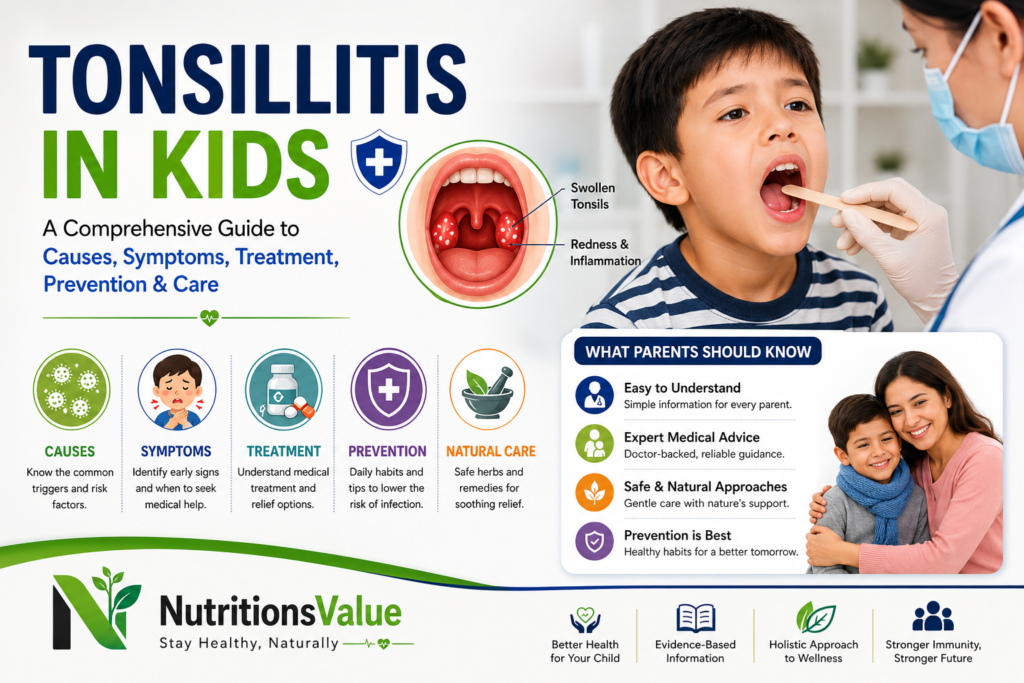
Tonsillitis in Kids is a common condition in which the tonsils the two small areas of tissue at the back of the throat become inflamed, usually because of a viral infection and sometimes because of bacteria such as Group A Streptococcus (strep). Children may develop a sore throat, fever, difficulty swallowing, swollen tonsils and sometimes white patches or pus on the tonsils.
For parents, tonsillitis can be worrying, especially when a child refuses food or complains that swallowing hurts. Fortunately, most cases are mild and improve with supportive care. However, some children need medical evaluation and, when bacterial tonsillitis is confirmed or strongly suspected by a healthcare professional, antibiotics may be required.
This comprehensive guide explains tonsillitis in kids, its causes, symptoms, diagnosis, treatment, home care, prevention and the safe role of herbs and natural remedies.
What Is Tonsillitis in Children?
Tonsils are part of the immune system and are located on both sides at the back of the throat. They help the body recognize and respond to germs entering through the mouth and nose.
Tonsillitis occurs when these tissues become inflamed or infected.
Children commonly develop tonsillitis because their immune systems are repeatedly exposed to respiratory viruses and other infections. Tonsillitis may occur as part of a common cold or another respiratory infection, but bacterial infections can also cause it.
Most childhood tonsillitis is viral and gets better without antibiotics. Bacterial tonsillitis, particularly infection caused by Group A Streptococcus, can require antibiotic treatment.
Tonsillitis vs. Strep Throat: Are They the Same?
Not exactly.
Tonsillitis describes inflammation of the tonsils, whereas strep throat refers specifically to a throat infection caused by Group A Streptococcus bacteria.
A child can have tonsillitis caused by:
- Viruses
- Group A Streptococcus
- Other bacteria
- Less commonly, other infections
Strep throat is particularly important in school-aged children. HealthyChildren.org notes that Group A Strep is the most common bacterial cause of sore throat and is particularly relevant in children aged approximately 5–15 years.
Because viral and bacterial infections can look similar, parents should not decide that a child needs antibiotics simply because the tonsils have white spots.
Causes of Tonsillitis in Kids
Viruses are the most common cause of tonsillitis in children.
Common respiratory viruses can produce:
- Sore throat
- Runny nose
- Cough
- Fever
- Tiredness
- Swollen tonsils
- Difficulty swallowing
When a cough, runny nose or hoarse voice accompanies the sore throat, a viral respiratory infection becomes more likely. Antibiotics do not treat viral infections.
Group A Streptococcus can cause bacterial throat infection and tonsillitis.
A child with strep throat may develop:
- Sudden sore throat
- Fever
- Pain while swallowing
- Swollen lymph nodes in the neck
- Red and swollen tonsils
- White patches or pus on the tonsils
- Headache
- Sometimes nausea, vomiting or abdominal discomfort
A cough and runny nose are more suggestive of a viral infection than classic strep throat.
Testing may be necessary because symptoms alone cannot always reliably distinguish viral from bacterial infection.
Tonsillitis Symptoms in Children
The symptoms vary depending on the child’s age and the cause of the infection.
Common symptoms include:
- Sore Throat
A child may complain that their throat hurts, burns or feels scratchy.
Younger children who cannot describe throat pain may simply refuse food or drinks.
- Difficulty Swallowing
Swallowing may become painful because the tonsils are swollen.
Children may:
- Eat less
- Drink less
- Refuse solid food
- Cry while swallowing
- Prefer cold or soft foods
- Fever
Fever may occur with both viral and bacterial infections.
A high or persistent fever, particularly when associated with severe throat pain or other concerning symptoms, deserves medical attention.
- Red or Swollen Tonsils
Parents may notice that the tonsils look larger than usual and appear red.
- White Spots or Patches
White patches, pus or spots can appear on infected tonsils.
However, white patches do not automatically mean that the infection is bacterial. A doctor may need to assess the overall symptoms and perform testing.
- Swollen Neck Glands
The lymph nodes in the neck can become enlarged and tender as the immune system responds to infection.
- Bad Breath
Tonsillitis may sometimes cause unpleasant breath.
- Headache or Tiredness
Children may become unusually tired, irritable or complain of headaches.
Pain from the throat can sometimes be felt around the ear.
- Nausea or Vomiting
Some children, particularly younger children, can experience stomach symptoms during throat infections.
NHS guidance lists sore throat, swallowing problems, fever, cough, headache, nausea/vomiting, earache, tiredness, swollen neck glands and white patches among possible tonsillitis symptoms.
How Long Does Tonsillitis Last in Kids?
The duration depends on the cause.
Many viral throat infections improve within several days, although some respiratory infections can take longer to completely resolve.
NHS guidance notes that tonsillitis symptoms commonly improve after around 3–4 days, although they can last longer.
If your child’s symptoms are getting worse rather than better, persist unusually long, or repeatedly return, consult a pediatrician.
When Should Parents Take a Child to the Doctor?
Parents should contact a healthcare professional if:
- The child has significant difficulty swallowing.
- The child is drinking very little.
- Fever persists or returns.
- Severe throat pain continues.
- The child repeatedly develops tonsillitis.
- Symptoms do not improve as expected.
- The child has swollen or very painful neck glands.
- You suspect strep throat.
- The child appears unusually weak or unwell.
A doctor may examine the throat and, when appropriate, perform a throat swab or rapid test to determine whether bacteria are responsible.
Emergency Signs of Tonsillitis in Children
Some complications are uncommon but potentially serious.
Seek urgent medical care if your child:
- Has difficulty breathing
- Cannot swallow saliva
- Is drooling excessively because swallowing is too painful
- Has rapidly increasing throat or mouth swelling
- Has severe throat pain that is rapidly worsening
- Has difficulty opening the mouth
- Has difficulty speaking
- Appears severely dehydrated
- Is unusually sleepy, confused or difficult to wake
These symptoms can indicate a serious throat infection or complication such as a peritonsillar abscess.
NHS guidance identifies difficulty breathing, inability to swallow, difficulty speaking, difficulty opening the mouth and rapidly worsening severe throat symptoms as emergency warning signs.
How Is Tonsillitis Diagnosed?
A pediatrician generally starts with:
- Medical history
- Symptom assessment
- Examination of the throat
- Examination of the neck lymph nodes
- Temperature and general health assessment
Depending on the symptoms, the doctor may recommend a throat swab or other testing for bacterial infection.
This is important because antibiotics should not be routinely given for viral tonsillitis.
Tonsillitis Treatment in Kids
Treatment depends mainly on whether the infection is viral or bacterial.
Viral Tonsillitis
Viral tonsillitis generally requires supportive care rather than antibiotics.
The goals are to:
- Keep the child hydrated
- Reduce throat discomfort
- Control fever when necessary
- Encourage rest
- Provide soft or comfortable foods
- Allow the immune system to clear the infection
Antibiotics do not work against viruses.
Bacterial Tonsillitis
When bacterial infection such as Group A Streptococcus is diagnosed and antibiotic treatment is indicated, the pediatrician may prescribe an appropriate antibiotic.
Parents should:
- Give the medicine exactly as prescribed.
- Follow the complete treatment instructions.
- Never use leftover antibiotics.
- Never share antibiotics between children.
- Never stop or change treatment without consulting the prescribing clinician.
Correct treatment of confirmed bacterial infection is important because some complications can be prevented with appropriate medical care.
Home Care for Tonsillitis in Kids
Home care can make a major difference in the child’s comfort.
- Encourage Fluids
Hydration is one of the most important parts of recovery.
Offer:
- Water
- Milk, if tolerated
- Oral rehydration fluids when appropriate
- Soups
- Broths
- Other age-appropriate fluids
Some children prefer cool drinks because they temporarily soothe an irritated throat.
NHS guidance recommends cool drinks for throat comfort, while pediatric guidance also supports fluids and rest during uncomplicated viral throat infections.
- Give Soft Foods
If swallowing hurts, try:
- Khichdi
- Soft rice
- Dal
- Soup
- Yogurt
- Mashed vegetables
- Oatmeal
- Soft fruits
- Other foods the child can swallow comfortably
Do not force a child to eat large meals. Fluids are particularly important when appetite is reduced.
- Encourage Rest
Adequate sleep and rest help a sick child recover.
Reduce strenuous activity until the child feels better.
- Fever and Pain Relief
Age-appropriate medicines such as acetaminophen/paracetamol or ibuprofen may be used when appropriate.
The dose should be based on the child’s age, weight and the specific product instructions, or according to the pediatrician’s recommendation.
Do not give aspirin to children unless specifically instructed by a healthcare professional.
Herbal Remedies for Tonsillitis in Kids: What Is Safe?
This is an important area because many parents prefer natural or herbal remedies.
The key principle is:
Natural does not automatically mean safe for children.
Children have smaller bodies and developing organs, and many herbal products have not been adequately studied for pediatric safety or effectiveness. NCCIH recommends discussing complementary approaches with a child’s healthcare provider and not replacing proven medical care with unproven products.
Therefore, herbal remedies should be considered supportive comfort measures—not cures for tonsillitis.
- Honey: One of the Most Useful Natural Options
Honey is not technically an herb, but it is one of the most useful natural foods for soothing throat irritation and cough in children.
Research suggests honey can help reduce nighttime coughing associated with respiratory infections in children.
How can parents use honey?
For children older than 1 year, a small amount of plain honey can be given directly or mixed into a warm—not very hot—drink.
AAP guidance gives age-based amounts such as:
- 1–5 years: about ½ teaspoon
- 6–11 years: about 1 teaspoon
- 12 years and older: about 2 teaspoons
Honey should never be given to babies under 12 months because of the risk of infant botulism.
Honey may soothe symptoms, but it does not kill the bacteria responsible for strep throat and should never replace prescribed antibiotics.
- Ginger
Ginger is traditionally used in many cultures for respiratory and digestive complaints.
A small amount of ginger incorporated into food or a mild beverage may be acceptable for some older children, but parents should understand that there is not strong evidence that ginger treats tonsillitis itself.
NCCIH notes that ginger research has focused on several other conditions and that oral ginger can sometimes cause abdominal discomfort, heartburn, diarrhea or mouth/throat irritation. Herbal products can also interact with medicines.
Safer approach
Instead of concentrated ginger supplements, parents who want to use ginger should generally prefer a small food-level amount in an age-appropriate drink or meal.
Avoid strong ginger preparations in young children unless a pediatrician recommends them.
- Turmeric
Turmeric is widely used as a culinary spice and contains curcumin, which has been studied for its biological effects.
However, parents should not assume that turmeric can cure tonsillitis.
There is insufficient evidence to recommend concentrated turmeric or curcumin supplements as a treatment for childhood tonsillitis.
A small culinary quantity of turmeric in normal food is very different from giving a concentrated herbal supplement.
Do not give high-dose turmeric/curcumin supplements to a child without pediatric medical advice.
- Tulsi (Holy Basil)
Tulsi is traditionally used in Indian households for various respiratory complaints.
However, traditional use is not the same as proven treatment.
There is not enough high-quality pediatric evidence to recommend concentrated tulsi preparations for treating tonsillitis.
If a family normally uses tulsi as a food or mild traditional beverage, discuss its use with the child’s pediatrician, particularly for younger children or children taking medicines.
Tulsi should not be used instead of medical evaluation when a child has severe symptoms.
- Licorice Root: Be Careful
Licorice is sometimes promoted for throat discomfort, but it is not a simple or automatically safe children’s remedy.
Concentrated licorice can have important effects on the body and may interact with medicines.
For this reason, parents should not independently give licorice-root supplements or concentrated preparations to children with tonsillitis.
- Echinacea and Other Herbal Supplements
Echinacea, garlic supplements, elderberry and other products are sometimes marketed for immunity or respiratory infections.
However, evidence is inconsistent or insufficient for many of these products, and children’s safety data are often limited.
NCCIH notes that complementary approaches in children frequently lack strong evidence, while herbal supplements may vary in ingredients and can have safety concerns.
Therefore:
Do not start an herbal supplement simply because it is marketed as an “immune booster” or “natural antibiotic.”
Herbal Remedies Parents Should Avoid Putting Directly on the Tonsils
Parents should not apply concentrated essential oils, herbal extracts, raw garlic, undiluted spices or unknown herbal mixtures directly to a child’s tonsils or throat.
These substances can irritate delicate throat tissue and may be harmful if swallowed.
Also avoid giving children concentrated essential oils by mouth unless specifically prescribed or recommended by a qualified healthcare professional.
A Simple Natural Comfort Routine for a Child With Tonsillitis
For a child older than 1 year with uncomplicated symptoms, parents can focus on simple supportive care:
Morning
- Offer water or another suitable fluid.
- Give a soft breakfast.
- If the child is over 1 year, a small amount of honey may help soothe throat irritation.
During the Day
- Encourage frequent fluids.
- Offer soft foods.
- Allow plenty of rest.
- Avoid very spicy or irritating foods if they increase discomfort.
Evening
- Offer a warm or cool drink according to what the child prefers.
- Honey may be considered for children over 1 year, especially if coughing is present.
- Follow the pediatrician’s instructions for any prescribed medicines.
This approach focuses on hydration, comfort and recovery rather than trying to “kill” the infection with herbs.
What Parents Should NOT Do
Avoid these common mistakes:
❌ Do not give antibiotics without medical advice
Antibiotics do not treat viral tonsillitis.
❌ Do not use leftover antibiotics
An antibiotic prescribed for another infection may be inappropriate.
❌ Do not force food
Encourage fluids and offer soft foods instead.
❌ Do not give honey to babies under 1 year
This can cause infant botulism.
❌ Do not give concentrated herbal supplements without advice
Children can react differently from adults, and many herbal products have limited pediatric safety data.
❌ Do not rely on herbal remedies for severe symptoms
Breathing difficulty, inability to swallow or rapidly worsening throat swelling requires urgent medical attention.
Tonsillitis Prevention in Children
Tonsillitis itself may not always be preventable, but reducing exposure to infectious germs can lower the risk of respiratory infections.
Encourage Frequent Handwashing
Children should wash their hands:
- Before eating
- After using the toilet
- After coughing or sneezing
- After returning from school or crowded places
Teach Cough and Sneeze Etiquette
Encourage children to cough or sneeze into a tissue or their elbow rather than directly toward others.
Avoid Sharing Personal Items
Do not encourage children to share:
- Cups
- Water bottles
- Spoons
- Food
- Toothbrushes
Keep Sick Children Home When Appropriate
If a child has fever and feels too unwell for normal activities, keeping them home can help with recovery and reduce transmission.
Respiratory infections that cause tonsillitis can spread through close contact and respiratory secretions.
Maintain Healthy Nutrition
A balanced diet supports normal immune function.
Children should regularly receive:
- Fruits
- Vegetables
- Whole grains
- Pulses
- Eggs or other suitable protein sources
- Dairy or alternatives
- Nuts/seeds when age-appropriate and safe
- Adequate fluids
No single food or herb can guarantee protection from tonsillitis.
Does Every Child With Tonsillitis Need Tonsil Surgery?
No.
Tonsillectomy—the surgical removal of the tonsils is not routinely required for a single episode of tonsillitis.
Most children recover without surgery.
Surgery may be considered in selected children who have severe, recurrent tonsillitis or other specific complications/problems, and the decision should be made with an ENT specialist and pediatric healthcare team. NHS guidance notes that tonsil removal is usually reserved for severe tonsillitis that repeatedly comes back.
Tonsillitis and Nutrition: What Should a Child Eat?
During the acute illness, the priority is hydration and comfortable eating, not forcing a perfect diet.
Good options can include:
- Warm or cool soups
- Dal
- Khichdi
- Soft rice
- Oatmeal
- Yogurt
- Mashed vegetables
- Soft fruits
- Smooth foods that the child tolerates
If acidic foods such as citrus fruits increase throat burning, temporarily avoid them.
Once the child feels better, gradually return to the normal balanced diet.
FAQ About Tonsillitis in Kids
- Is tonsillitis dangerous in children?
Most cases are not dangerous and improve with supportive care. However, serious complications can occasionally occur, so parents should recognize emergency warning signs such as breathing difficulty, inability to swallow or rapidly worsening throat swelling.
- Can tonsillitis go away without antibiotics?
Yes. Most childhood tonsillitis is viral and can resolve without antibiotics. Bacterial tonsillitis may require antibiotics after appropriate medical assessment.
- Can honey cure tonsillitis?
No. Honey may soothe throat irritation and reduce cough, but it does not cure bacterial tonsillitis. Never use honey in children younger than 1 year.
- Can turmeric cure tonsillitis?
There is no good evidence that turmeric cures tonsillitis in children. Culinary use is different from giving concentrated turmeric supplements.
- Can ginger be given to children?
Small food-level amounts may be tolerated by some children, but ginger is not a proven treatment for tonsillitis. Concentrated supplements should be discussed with a healthcare professional. Ginger can cause digestive or throat irritation in some people.
- Should I give my child an herbal antibiotic?
No. Products marketed as “natural antibiotics” should not be used as a replacement for medically indicated antibiotics.
- Why does my child have white patches on the tonsils?
White patches can occur with tonsillitis, including bacterial infections, but they do not by themselves prove that the infection is bacterial. A healthcare professional may recommend testing.
- Can my child go to school with tonsillitis?
This depends on the child’s symptoms, fever, overall condition and the cause of infection. If the child is feverish or too unwell for normal activities, staying home is appropriate. Follow your pediatrician’s advice and your school’s infection-control policy.
- Can tonsillitis keep coming back?
Yes. Some children experience recurrent tonsillitis. Repeated severe infections should be discussed with a pediatrician or ENT specialist.
Key Points for Parents
Tonsillitis is common during childhood and is usually caused by a virus. Bacterial infections such as Group A Streptococcus can also cause tonsillitis and may require antibiotic treatment.
The most important things parents can do are:
- Keep the child hydrated.
- Provide comfortable soft foods.
- Encourage rest.
- Use age-appropriate pain or fever medicines according to medical advice.
- Do not give antibiotics without appropriate medical guidance.
- Honey can soothe cough/throat symptoms in children over 1 year, but it is not a cure.
- Use herbs cautiously because many herbal products have limited pediatric safety and effectiveness data.
- Avoid concentrated herbal supplements and essential oils unless a healthcare professional recommends them.
- Seek medical evaluation when symptoms are severe, persistent or recurrent.
- Get urgent help if the child has difficulty breathing, cannot swallow, has rapidly worsening swelling or cannot open the mouth normally.
Final Word
For parents looking for natural ways to support a child with tonsillitis, the safest strategy is to think of herbs and natural foods as comfort-supportive options—not replacements for diagnosis and evidence-based treatment.
Simple measures such as fluids, rest, soft foods and, for children over 1 year, a small amount of honey can provide comfort. Ginger or culinary amounts of herbs such as turmeric or tulsi may be used as foods when appropriate, but there is not enough evidence to claim that they cure tonsillitis.
Most importantly, never allow a natural remedy to delay medical treatment when a child has signs of a serious infection or when bacterial tonsillitis requires antibiotics. Children’s safety should always come before the idea that a treatment is “natural.”