
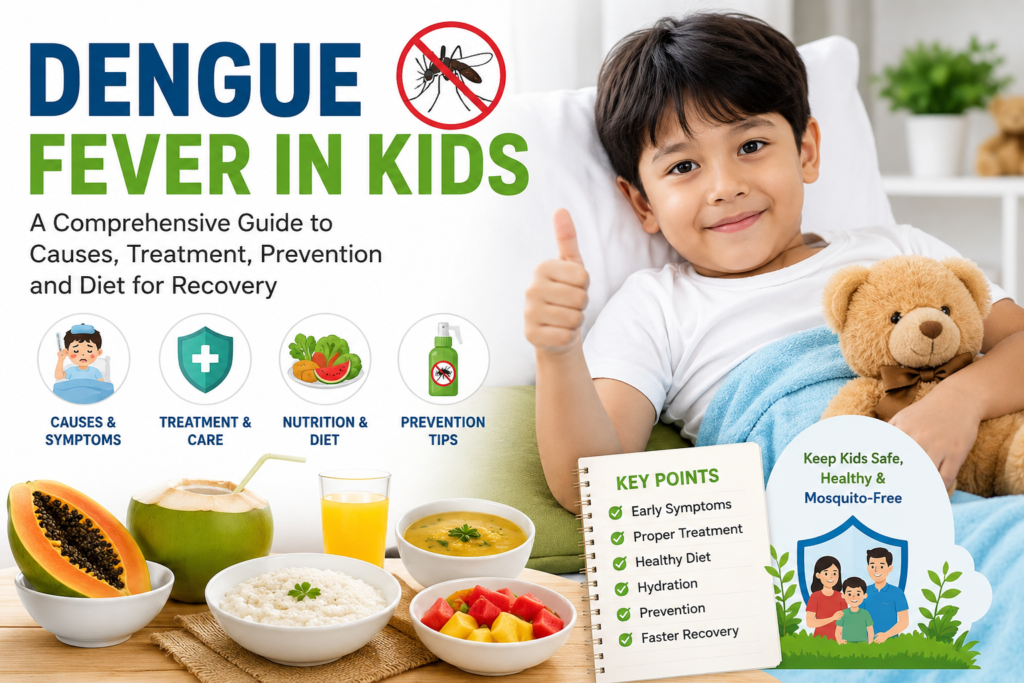
Dengue fever in children can be frightening for parents, especially when a child develops high fever, weakness, vomiting or a falling platelet count. However, understanding the disease, recognizing warning signs early, maintaining appropriate hydration and providing nutritious, easily digestible food can help parents support their child’s recovery.
Dengue is a viral infection transmitted mainly by infected Aedes mosquitoes. Most children with uncomplicated dengue recover with appropriate supportive care, but some children can develop severe dengue, which requires urgent medical treatment and sometimes hospitalization.
This comprehensive guide explains dengue in kids, symptoms, causes, dengue fever stages, warning signs, diagnosis, treatment, hydration, dengue diet for children, foods to eat, foods to avoid, platelet myths, papaya, coconut water, recovery and prevention.
Important medical disclaimer: This article is for educational purposes and does not replace a pediatrician’s examination or treatment. If your child has suspected dengue, consult a qualified healthcare professional. If warning signs develop, seek urgent medical care.
What Is Dengue Fever in Children?
Dengue is a viral infection caused by the dengue virus (DENV). It is transmitted mainly through the bite of an infected female Aedes mosquito.
Dengue is common in tropical and subtropical regions, including India and many other Asian countries. The mosquitoes that transmit dengue are particularly active during the daytime.
Children can develop dengue after being bitten by an infected mosquito. The illness may range from mild fever to severe dengue involving bleeding, plasma leakage, shock or organ problems.
The good news is that most people with dengue recover, but parents need to monitor children carefully because severe symptoms can develop around the time the fever starts to decrease.
What Causes Dengue in Kids?
Dengue is caused by dengue virus infection.
The transmission cycle is simple:
- An infected mosquito bites a person carrying dengue virus.
- The mosquito becomes infected.
- The virus multiplies inside the mosquito.
- The infected mosquito bites another person.
- The virus enters that person’s bloodstream.
The principal mosquito responsible is Aedes aegypti, although Aedes albopictus can also transmit dengue in some regions.
Dengue does not normally spread directly from one child to another through ordinary casual contact.
However, a child with dengue can contribute to transmission if an uninfected mosquito bites the child while the virus is present in the child’s blood and later bites another person. Therefore, mosquito protection is important even after a child becomes sick.
Dengue Symptoms in Children
Dengue symptoms can begin several days after an infected mosquito bite.
Common symptoms include:
- High fever
- Headache
- Body aches
- Muscle pain
- Joint pain
- Pain behind the eyes
- Nausea
- Vomiting
- Skin rash
- Swollen glands
- Loss of appetite
- Weakness
- Tiredness
WHO reports that symptomatic dengue commonly begins around 4–10 days after infection, with symptoms generally lasting around 2–7 days.
Not every child develops all symptoms.
Dengue Fever Stages in Children
Understanding the stages can help parents know why monitoring remains important even after fever improves.
- Febrile Phase
During this stage, the child may have:
- High fever
- Headache
- Body pain
- Poor appetite
- Nausea
- Vomiting
- Rash
The child may look tired and may not want to eat.
The main nutritional concern during this phase is usually maintaining adequate fluid intake and providing food according to the child’s tolerance.
- Critical Phase
This is the stage parents must understand carefully.
The critical phase may occur when the fever begins to decrease, often around the third to seventh day of illness.
A common misconception is:
“The fever has gone down, so my child is getting better.”
This is not always true.
Warning signs of severe dengue can appear around the time the fever subsides.
Parents should therefore continue monitoring the child even when the temperature becomes normal.
- Recovery Phase
If the child passes the critical phase without complications, recovery begins.
The child’s:
- Appetite may improve
- Urination may become normal
- Energy gradually returns
- General condition improves
However, tiredness can continue for some time after dengue. WHO notes that fatigue may persist for several weeks after recovery.
Dengue Warning Signs in Children
This is the most important section for parents.
Seek urgent medical care if a child with suspected or confirmed dengue develops any warning signs.
These may include:
Severe abdominal pain
A child may complain of strong stomach pain or repeatedly cry, curl up or resist being touched because of abdominal discomfort.
Persistent vomiting
Occasional vomiting can occur with dengue, but repeated or persistent vomiting is a warning sign.
Bleeding
Watch for:
- Bleeding gums
- Nosebleeds
- Blood in vomit
- Blood in stool
- Black stools
- Unusual bleeding
Difficulty breathing or rapid breathing
This requires urgent evaluation.
Extreme weakness
A child who becomes unusually weak, floppy or difficult to wake should receive immediate medical attention.
Restlessness or unusual behavior
A child may become unusually restless, irritable, confused or excessively sleepy.
Pale, cold skin
Cold or pale hands and feet combined with weakness can be a serious warning sign.
Excessive thirst
Unusual thirst can indicate significant fluid problems.
Reduced urination
If the child is passing much less urine than usual, particularly for several hours, contact the treating doctor urgently.
WHO identifies severe abdominal pain, persistent vomiting, bleeding, rapid breathing, lethargy/restlessness, blood in vomit or stool, excessive thirst and pale/cold skin among important warning signs requiring immediate care.
Do not wait for the platelet count to fall before seeking emergency care.
How Is Dengue Diagnosed in Children?
A pediatrician may consider:
- Symptoms
- Physical examination
- Fever duration
- Local dengue activity
- Medical history
- Blood tests
Depending on the stage of illness, doctors may use laboratory tests that detect viral components or antibodies.
A CBC (Complete Blood Count) may also be performed and repeated when clinically indicated.
Doctors may monitor:
- Platelet count
- Hematocrit
- White blood cell count
- Hydration status
- Urine output
- Other relevant laboratory parameters
The platelet count should not be interpreted by parents in isolation.
Dengue Treatment in Kids
There is currently no specific antiviral medicine that cures dengue. Treatment is primarily supportive and focuses on hydration, safe fever/pain management, monitoring and prompt treatment of complications.
For children with uncomplicated dengue, doctors may recommend:
- Adequate oral fluids
- Rest
- Appropriate fever management
- Nutritious food according to appetite
- Monitoring for warning signs
- Follow-up blood tests when required
Children who cannot maintain adequate hydration or who develop warning signs may require hospital care.
Dengue and Hydration in Children
Hydration is one of the most important aspects of dengue care.
Fever, sweating, vomiting and reduced food and fluid intake can increase the risk of dehydration.
WHO’s current clinical guidance recommends frequent small amounts of oral fluid, especially when nausea or poor appetite makes drinking difficult. Water should be the main source of fluids, with standardized ORS and other appropriate fluids used according to the child’s condition.
What Can Parents Give?
Depending on the child’s age, condition and doctor’s advice:
- Safe drinking water
- ORS
- Light soups
- Coconut water
- Unsweetened suitable fluids
- Milk or yogurt drinks if tolerated
- Other locally appropriate fluids
For a child who feels nauseated, small frequent sips are often easier than a large glass at once.
How Can Parents Monitor Hydration?
Parents can monitor:
- How much the child drinks
- How often the child urinates
- Whether the mouth appears unusually dry
- Whether the child is alert and active enough
- Whether vomiting prevents fluid intake
WHO clinical guidance notes that adequate oral fluid intake should generally result in urination around 4–6 times per day, although individual circumstances and age matter. Parents should follow their pediatrician’s specific instructions.
Do not force excessive amounts of fluid.
In dengue, fluid management can become complicated, particularly during the critical phase. A child with warning signs may require careful medical monitoring rather than simply being given more fluids at home.
ORS for Children With Dengue
ORS can be useful for replacing water and electrolytes when clinically appropriate.
Use standard commercially prepared ORS according to the package instructions.
Do not make the solution more concentrated or dilute it excessively.
If the child vomits after drinking:
- Wait briefly according to medical advice.
- Try very small, frequent amounts.
- If vomiting continues or the child cannot maintain fluids, contact the doctor.
Persistent vomiting is itself a dengue warning sign and should not be managed only with home remedies.
What Should a Child Eat During Dengue?
The basic principle is:
Give nutritious food according to the child’s appetite and tolerance.
A sick child may not want a full meal.
Do not force a large plate of food.
Instead, offer small, frequent meals.
Good options include:
- Soft rice
- Khichdi
- Dalia
- Oatmeal
- Moong dal
- Soft vegetables
- Banana
- Apple
- Papaya
- Orange or sweet lime
- Curd
- Milk, if tolerated
- Egg
- Soft chicken or fish, if normally eaten
- Light soup
A varied diet based on cereals, pulses, vegetables, fruits and appropriate animal-source foods supports healthy nutrition in children. WHO emphasizes adequacy, balance, moderation and dietary diversity as the foundation of a healthy diet.
Best Foods for Kids During Dengue
- Khichdi
Khichdi can be a practical option because it combines:
- Rice
- Dal
- Energy
- Protein
It can be prepared soft and lightly seasoned so that it is easier to eat.
- Moong Dal
Moong dal provides protein and can be prepared as a thin, soft dal.
It may be easier to tolerate than heavy, spicy or oily foods.
- Rice or Dalia
These foods provide carbohydrates, which are an important source of energy.
A child with fever may tolerate soft foods better than heavy meals.
- Banana
Banana is soft and generally easy to eat.
It provides carbohydrates and potassium.
Give an amount appropriate for the child’s age and appetite.
- Papaya
Papaya can be included as a normal fruit if the child likes it and tolerates it.
However, parents should understand an important point:
Papaya is a food, not a dengue treatment.
There is no reason to force a child to eat papaya simply because someone claims it will rapidly increase platelets.
- Orange and Sweet Lime
These fruits can provide fluid and vitamin C.
If the child has nausea or stomach discomfort, give small quantities according to tolerance.
Whole fruit is generally preferable to large quantities of sweetened packaged juice.
- Apple
Soft apple pieces, stewed apple or applesauce may be suitable depending on the child’s age and appetite.
- Cooked Vegetables
Well-cooked vegetables can provide important vitamins, minerals and other nutrients.
Examples include:
- Carrot
- Pumpkin
- Bottle gourd
- Spinach
- Beans
- Peas
- Eggs
Eggs are a convenient source of protein.
If the child normally eats eggs and has no allergy or dietary restriction, a well-cooked egg can be included when appetite allows.
- Curd and Milk
Curd or milk can be included if the child normally tolerates dairy products.
However, do not force dairy if it worsens nausea, vomiting, bloating or diarrhea.
Protein Is Important During Dengue Recovery
Some parents focus almost entirely on fruit juices when their child has dengue.
A better approach is to provide a balanced diet.
Protein helps support normal growth and tissue maintenance.
Child-friendly protein sources include:
- Dal
- Beans
- Eggs
- Milk
- Curd
- Paneer
- Soy
- Chicken
- Fish
The amount required varies according to age, body size and health status.
If a child has kidney, liver or another medical condition requiring dietary restrictions, ask the pediatrician before making major dietary changes.
One-Day Sample Dengue Diet for a Child
This is a general example, not an individualized prescription.
Breakfast
Soft dalia or oatmeal + banana
Mid-morning
Water or an appropriate fluid
Lunch
Soft khichdi + cooked vegetables + curd if tolerated
Afternoon
Fruit + suitable fluid
Evening
Light soup or soft snack
Dinner
Rice + moong dal + cooked vegetables
Before bedtime
Water or another appropriate fluid according to the child’s needs and doctor’s advice
Important: Fluid quantity and diet should be individualized for infants, very young children, children with vomiting, children with warning signs and children with underlying medical conditions.
Foods and Drinks to Limit During Dengue
There is no universal “forbidden food list,” but some foods may be inappropriate or poorly tolerated.
Avoid very oily foods
Examples:
- Deep-fried snacks
- Pakoras
- Fried chips
- Very oily curries
These may worsen nausea or stomach discomfort.
Avoid very spicy foods
If the child has nausea, vomiting or abdominal discomfort, spicy food may make eating more difficult.
Limit sugary drinks
Avoid making:
- Soft drinks
- Sweetened packaged juices
- Sweetened tea
- Syrups
the main source of hydration.
WHO’s dengue clinical guidance specifically advises avoiding highly sugary commercial drinks because they may worsen hyperglycemia associated with dengue.
Avoid unsafe food
Children recovering from dengue should receive hygienically prepared food.
Avoid:
- Stale food
- Undercooked foods
- Unwashed fruits and vegetables
- Food stored improperly
- Food prepared in unhygienic conditions
WHO emphasizes that a healthy diet must also be safe from microbial and chemical contamination.
Can Children Drink Coconut Water & Fruit Juice During Dengue?
Coconut water can be used as one of several fluids if the child tolerates it.
It provides fluid and electrolytes.
However:
Coconut water is not a treatment for dengue.
It should not replace ORS when ORS is indicated, and it should not replace medical care.
Children with kidney disease or conditions affecting potassium balance may require specific dietary advice.
Can Children Drink Fruit Juice During Dengue?
A small amount of appropriate fruit juice may be tolerated.
However, whole fruits are generally preferable to large amounts of juice because whole fruit also provides fiber and avoids a concentrated intake of free sugars.
Do not use packaged sugary juices as the child’s primary hydration source.
WHO’s healthy-diet guidance recommends emphasizing whole fruits and limiting free sugars.
What Medicine Can Be Given to a Child With Dengue?
Never give a child’s medicine based only on an adult’s dose.
For fever and discomfort, doctors may recommend paracetamol/acetaminophen at an age- and weight-appropriate dose.
WHO recommends paracetamol for dengue fever and advises against aspirin and ibuprofen because they can increase bleeding risk.
Do NOT give aspirin or ibuprofen unless specifically instructed by the treating doctor.
This is particularly important in children.
Do not give multiple combination cold/fever medicines without checking their ingredients, because more than one product may contain paracetamol.
Why Should Aspirin Be Avoided in Children With Dengue?
Aspirin can increase bleeding risk.
In children, aspirin also has additional safety concerns.
Therefore, parents should never independently use aspirin for a child’s suspected dengue fever.
Should a Child With Dengue Take Antibiotics?
Dengue is caused by a virus, so antibiotics do not treat dengue itself.
Antibiotics should only be used if a doctor diagnoses or strongly suspects a bacterial infection requiring them.
Do not start antibiotics simply because the fever is high.
Dengue and Rest for Children
Rest is an important part of recovery.
During the acute illness:
- Let the child sleep adequately.
- Avoid strenuous physical activity.
- Do not force school attendance.
- Encourage quiet activities.
- Avoid sports and vigorous exercise.
After recovery, physical activity should be increased gradually.
A child may remain tired for some time even after the fever disappears.
Dengue Prevention for Kids
The best protection is to reduce mosquito bites and eliminate mosquito breeding sites.
Because dengue mosquitoes can bite during the daytime, children need protection both during the day and at night.
Use mosquito protection
Depending on age and product instructions:
- Use appropriate mosquito repellent.
- Dress children in clothing that covers arms and legs.
- Use window screens.
- Use mosquito nets where appropriate.
- Follow the product label for repellent use.
Parents should select repellents appropriate for the child’s age and use them exactly according to the label.
Eliminate Stagnant Water
Mosquitoes can breed in relatively small collections of water.
Check around the home for:
- Buckets
- Flowerpot trays
- Old tyres
- Coolers
- Open water containers
- Uncovered tanks
- Plastic containers
- Discarded bottles
- Roof gutters
WHO recommends removing artificial habitats that hold water and regularly emptying, cleaning and covering domestic water-storage containers.
A weekly mosquito-breeding check should become a family habit.
Protect Other Family Members When a Child Has Dengue
If your child has dengue, mosquito protection becomes especially important.
The infected child should be protected from mosquito bites so mosquitoes do not acquire the virus and potentially transmit it to others.
Practical measures include:
- Mosquito net during sleep
- Appropriate mosquito repellent
- Screens on windows and doors
- Eliminating stagnant water
- Reducing mosquito exposure during the day
WHO notes that infected people can transmit dengue virus to mosquitoes during the early illness period, making mosquito-bite prevention around the patient important.
Dengue Recovery in Children
Many children with uncomplicated dengue recover within one to two weeks.
However, recovery is gradual.
During recovery:
Continue hydration
Do not stop paying attention to fluids immediately after the fever disappears.
Restore appetite gradually
Return to a normal balanced diet as appetite improves.
Include protein
Continue dal, eggs, dairy, beans, fish or chicken according to the child’s normal diet.
Include fruits and vegetables
These provide a wide range of nutrients.
Allow adequate rest
Do not immediately send a weak child back to intense sports or physical activity.
Resume school gradually
The child should return when medically appropriate and when energy and overall condition have improved.
When Should a Child Return to Normal Activity?
There is no single timetable suitable for every child.
A child recovering from dengue should gradually return to normal activities once:
- Fever has resolved
- Appetite is improving
- Hydration is adequate
- Energy is returning
- The doctor considers the child clinically stable
If the child remains unusually weak or develops new symptoms, consult the pediatrician.
Dengue in Babies, Toddlers and School-Age Children
Extra caution is needed with babies and toddlers.
They may not be able to tell parents:
- Where they hurt
- Whether they feel dizzy
- Whether they have abdominal pain
- How severe their weakness is
Parents should therefore watch:
- Feeding
- Fluid intake
- Urination
- Alertness
- Vomiting
- Fever
- Breathing
- Skin color
- Unusual sleepiness or irritability
Very young children with suspected dengue should receive medical assessment, particularly if they are not drinking adequately or appear unusually unwell.
WHO’s clinical guidance recognizes infants and young children among groups requiring particular attention in dengue management.
Dengue in School-Age Children
School-age children can usually describe symptoms more clearly, but parents should still monitor them carefully.
Ask the child:
- Does your stomach hurt?
- Do you feel dizzy?
- Are you feeling unusually weak?
- Are you having trouble breathing?
- Have you vomited repeatedly?
- Are you drinking enough?
- Are you urinating normally?
Keep a simple record of:
- Temperature
- Fluid intake
- Vomiting episodes
- Urination
- Medicines given
- New symptoms
This information can be useful when communicating with the pediatrician.
A Parent's Dengue Care Checklist
During fever
- Consult a pediatrician.
- Monitor the child’s temperature and symptoms.
- Encourage appropriate fluids.
- Offer small, frequent meals.
- Give medicines only as advised.
- Avoid aspirin and ibuprofen unless specifically prescribed.
- Encourage rest.
- Protect the child from mosquito bites.
During the critical period
- Continue monitoring even if fever decreases.
- Watch for abdominal pain.
- Watch for persistent vomiting.
- Look for bleeding.
- Monitor urination.
- Watch for unusual sleepiness or restlessness.
- Seek urgent medical care if warning signs appear.
During recovery
- Continue adequate fluids.
- Gradually restore normal diet.
- Include protein-rich foods.
- Include fruits and vegetables.
- Allow adequate rest.
- Resume physical activity gradually.
- Follow the pediatrician’s follow-up instructions.
Can Herbal Remedies Help Prevent Dengue in Children?
- Lemongrass
The aroma of lemongrass is associated with mosquito-repellent properties, and there is some laboratory or experimental research regarding its essential oil. However, growing lemongrass at home or drinking lemongrass tea cannot be considered a proven method for preventing dengue.
- Neem
Research on mosquito control has been conducted on certain compounds found in neem. However, consuming neem leaves, drinking neem tea, or applying concentrated neem oil to the body is not a proven method of protection against dengue. Concentrated herbal preparations should be strictly avoided for children.
- Citronella
Citronella oil is used in mosquito-repellent products; however, its effectiveness depends on the product’s concentration and formulation. Instead of applying essential oil directly to children, it is better to use age-appropriate, properly formulated mosquito repellents in accordance with label instructions or medical advice.
- Tulsi (Holy Basil)
Tulsi is widely used in traditional medicine, and while there are laboratory studies linking it to mosquito-related effects, there is insufficient clinical evidence to prove that consuming Tulsi or drinking Tulsi tea prevents dengue infection.
FAQ About Dengue in Kids
What is the best food for a child with dengue?
There is no single best food. A combination of appropriate fluids, ORS when indicated, soft carbohydrates, protein-rich foods, fruits and vegetables is generally more useful.
Is papaya good for children with dengue?
Papaya fruit can be included if the child tolerates it, but it should not be considered a dengue treatment or guaranteed platelet booster.
Can children drink coconut water during dengue?
Yes, it may be included as one suitable fluid if tolerated, but it is not a substitute for medical treatment or ORS when ORS is required.
Can a child eat eggs during dengue?
Yes, if the child normally eats eggs, has no allergy and can tolerate them. Eggs provide protein.
Can a child eat chicken during dengue?
Well-cooked, lightly prepared chicken can provide protein if the child tolerates it.
Can children drink milk during dengue?
Milk can be given if normally tolerated and if it does not worsen nausea, vomiting or digestive symptoms.
Should children drink lots of fruit juice?
No. Excessive juice is not necessary and can provide large amounts of sugar. Whole fruit and appropriate fluids are generally preferable.
Can a child with dengue eat rice?
Yes. Soft rice, rice porridge and khichdi can be useful sources of energy.
Can a child eat dal?
Yes. Dal is a useful protein-containing food and can be prepared soft and easy to digest.
How can I increase my child’s platelet count naturally?
Do not focus exclusively on platelet numbers or try multiple unproven remedies. Follow the pediatrician’s monitoring and treatment plan. Nutrition supports recovery but is not a substitute for medical treatment.
Is dengue dangerous for children?
Most dengue infections are not severe, but some children can develop severe dengue. Early recognition of warning signs and timely medical care are extremely important.
What should I do if my child’s fever suddenly goes away?
Continue monitoring the child. The critical phase may occur around the time fever decreases, so a falling temperature does not automatically mean the danger has passed.
Final Takeaway for Parents
Dengue in children requires careful observation, appropriate medical guidance, hydration, rest and nutritious food.
There is no miracle food that cures dengue.
The most important priorities are:
Early medical evaluation → adequate hydration → safe fever management → nutritious food according to appetite → monitoring for warning signs → timely medical care.
Parents should remember that the platelet count is only one part of dengue management. A child’s overall condition, hydration, urination, bleeding, breathing, abdominal symptoms and behavior are extremely important.
When the child begins to recover, gradually return to a normal balanced diet containing:
- Whole grains and other healthy carbohydrates
- Dal and pulses
- Eggs or other protein foods
- Milk/curd if tolerated
- Fruits
- Vegetables
- Adequate fluids
WHO recommends a diverse, balanced diet based on minimally processed foods, with nutrition needs adapted to age and individual circumstances.
Most importantly, never delay medical care because of a home remedy, papaya leaf preparation, fruit juice or a belief that the platelet count alone determines the severity of dengue.
If a child develops severe abdominal pain, persistent vomiting, bleeding, rapid breathing, unusual sleepiness/restlessness, pale or cold skin, extreme weakness, blood in vomit or stool, or reduced urination, seek urgent medical care immediately.
Medical Disclaimer
This article is published for educational and nutritional information only. It is not intended to diagnose, treat, cure or prevent dengue or any other disease. Children with suspected dengue should be evaluated by a qualified pediatrician or healthcare professional. Medication doses, fluid requirements, blood-test interpretation and hospitalization decisions must be determined by the treating healthcare professional.
References
World Health Organization — Dengue and severe dengue.
World Health Organization — Dengue and severe dengue: Questions and Answers.
WHO South-East Asia Regional Office — Dengue case management for primary health care and home-based care.
WHO — Clinical management of arboviral diseases, including dengue.
WHO — Healthy diet.
WHO — Paediatric Drug Optimization Process for Dengue, 2026.