
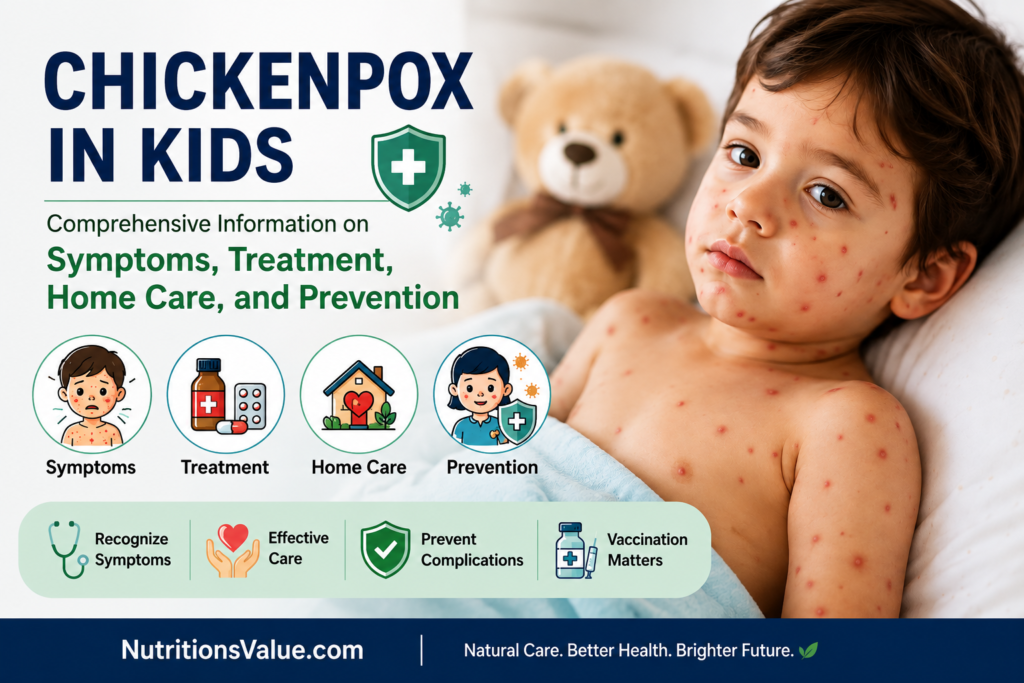
Chickenpox is a highly contagious viral infection that affects children. It is also known as Varicella. It typically presents with fever, weakness, and the appearance of small red spots on the body; these later turn into itchy, fluid-filled blisters and eventually dry up to form scabs.
In most healthy children, chickenpox is mild, and the child begins to recover within a few days. However, it should not be completely ignored, as complications such as bacterial skin infections, pneumonia, or in very rare cases brain inflammation can occur in some children. According to the WHO, while chickenpox is generally mild in children, it can be severe in infants, children with weakened immune systems, and other high-risk individuals.
This article provides parents with comprehensive information regarding symptoms, stages, treatment, home care, dietary advice, itch control, medication precautions, when to see a doctor, and prevention strategies for chickenpox in children.
Children can develop several common infectious illnesses. Parents may also want to learn about measles in children.
What is Chickenpox?
Chickenpox is an infection caused by the Varicella-Zoster Virus (VZV). This virus spreads very easily from person to person.
The infection can spread through respiratory droplets or aerosols released when an infected person coughs or sneezes, or through direct contact with fluid from the chickenpox blisters. An infected person can be contagious from about 1–2 days before the rash appears and can continue to spread the infection until all lesions have crusted over (turned into scabs).
For this reason, if one child in a school, daycare, or household contracts chickenpox, the infection can spread rapidly to other susceptible children.
How does Chickenpox start in children?
Chickenpox symptoms do not appear immediately after exposure. Symptoms typically appear within 10–21 days of exposure to the virus. According to the WHO, the incubation period is usually around 14–16 days.
Initially, the child may experience:
* Mild or high fever
* Weakness
* Fatigue
* Loss of appetite
* Headache
* General body discomfort
Following this, the characteristic chickenpox rash begins to appear.
Main Symptoms of Chickenpox in Children
The most important symptom for identifying chickenpox is its typical rash.
- Small red spots
Small red spots may appear first. They often start on the face and scalp and spread to other parts of the body.
- Small fluid-filled blisters
After some time, the red spots turn into small, itchy, fluid-filled blisters.
This is the most recognizable sign of chickenpox.
- Intense itching
Itching associated with chickenpox can be the most troublesome issue for children.
The child may repeatedly scratch the spots; however, scratching increases the risk of skin damage and secondary bacterial infection.
- Fever
Some children may develop a fever before or during the rash.
- Loss of appetite
The child may want to eat less than usual during the illness. Staying hydrated becomes crucial during this time.
- Body weakness
The child may appear tired or less active than usual.
Why is it important to understand the stages of the chickenpox rash?
The chickenpox rash does not look the same all over the body at the same time.
On a single child’s body, one might see:
* New red spots
* Small bumps
* Fluid-filled blisters
* And drying scabs
all appearing simultaneously.
According to the WHO, the rash goes through various stages over about 5–7 days, and the blisters eventually turn into crusts or scabs.
Once the scab forms, it should not be picked off.
How long does chickenpox last in children?
It can vary slightly from child to child.
Typically, the rash develops and begins to crust over within about 5–7 days. It may take longer for the scabs to disappear completely. According to the WHO, the entire rash and scab process can take about 2–4 weeks, although the child’s general condition often begins to improve before that.
Most importantly, a child is considered contagious until all the chickenpox lesions have crusted or scabbed over.
What is the treatment for chickenpox in children?
In healthy children, chickenpox treatment is generally based on supportive care. This means that instead of directly eliminating the virus, the focus is on managing symptoms such as fever, itching, discomfort, and dehydration.
According to the WHO, most healthy individuals do not require specific antiviral treatment. However, in certain high-risk or severe cases, a doctor may recommend antiviral medication like acyclovir.
Therefore, parents should not start antiviral medication on their own.
How can you care for a child with chickenpox at home?
- Give the child plenty of fluids
Chickenpox can lead to dehydration due to fever and reduced food or fluid intake.
Depending on the child’s age, you can offer:
* Water
* Milk
* ORS (if recommended by a doctor or pharmacist)
* Soup
* Coconut water
* Other common fluids
If the child is drinking little water, it might be easier to offer small amounts frequently.
The NHS also recommends providing adequate fluids during chickenpox.
- Try to reduce itching
To alleviate itching:
Keep the child’s nails short.
Soft gloves or socks can be used at night to prevent scratching.
Dress the child in loose cotton clothing.
Avoid dressing them in overly warm clothes.
A cool or lukewarm bath can provide relief.
After bathing, gently pat the skin dry instead of rubbing it.
According to the NHS, cooling creams/gels and, in some cases, antihistamines can help with itching; it is best to consult a pharmacist or doctor regarding medication.
Should a child with chickenpox be bathed?
Yes, generally, the child can be bathed.
There is no need to avoid bathing when the child has chickenpox.
Bathing with cool or lukewarm water can help reduce itching and discomfort. After the bath, dry the skin gently rather than rubbing it vigorously with a towel.
It is best to avoid very hot water, as heat can aggravate itching.
What should be eaten during chickenpox?
Instead of forcing the child to eat during the illness, focus on hydration and nutritious, easy-to-eat foods.
Depending on the child’s age and preferences, the following can be given:
soft rice
khichdi (rice and lentil porridge)
dalia (broken wheat porridge)
dal (lentils)
vegetable soup
soft fruits
banana
apple puree
curd (if the child usually consumes it)
milk (if tolerated)
If there are chickenpox lesions inside the mouth, very spicy, salty, or acidic foods may cause discomfort.
In such cases, soft and relatively bland foods are preferable.
Should herbs or home remedies be used for chickenpox?
Parents often ask about using neem, turmeric, tulsi (holy basil), or other herbal remedies for chickenpox.
It is important to understand that herbal remedies are not a proven treatment for eliminating the chickenpox virus.
Do not apply the following to the child’s skin without medical advice:
concentrated herbal pastes
essential oils
unknown creams
strong antiseptics
homemade chemical preparations Applying any substance especially to open or ruptured blisters can carry a risk of irritation or infection.
If you wish to use an herbal product, it is safer to consult a pediatrician first.
Which medicines should be administered with caution during chickenpox?
This section is very important for parents.
Do not give aspirin at all.
Children with chickenpox should not be given aspirin unless specifically instructed by a specialist for a medical reason.
In children and teenagers, aspirin use during viral infections is linked to Reye’s syndrome, a rare but serious condition. The NHS also advises against giving aspirin to children under the age of 16.
Do not administer ibuprofen on your own.
Special caution is required regarding ibuprofen during chickenpox.
According to the NHS, ibuprofen should not be given to a child with chickenpox without a doctor’s advice, due to concerns about serious skin reactions or infections.
Therefore, parents should not start administering ibuprofen on their own, even if the child has a fever.
Paracetamol
Paracetamol is a commonly used option for fever or discomfort associated with chickenpox, but the correct dosage based on the child’s age and weight is essential.
Always administer the dose according to the pediatrician’s advice or the medicine label.
Do not simultaneously administer multiple medicines that already contain paracetamol.
Are antibiotics needed for chickenpox?
Chickenpox is a viral infection.
Therefore, antibiotics do not work to treat uncomplicated chickenpox.
However, if a bacterial infection develops around the blisters due to scratching, a doctor may recommend antibiotic treatment.
Therefore, do not start antibiotics on your own.
When should a child with chickenpox be sent to school?
Chickenpox is highly contagious.
A child should not be sent to school, daycare, or crowded public places until all the lesions have turned into crusts or scabs.
According to the NHS, this usually happens about five days after the rash appears, though the timing can vary for each child.
Simply observing that the child has become active again is not a sufficient reason to send them to school.
Who should be kept away from someone with chickenpox?
A child with chickenpox should be kept away from the following people in particular:
newborn babies
pregnant women whose immunity status is unclear
people with weakened immune systems
people with certain serious medical conditions
Chickenpox can be more severe in these groups.
If there is a pregnant woman, a newborn, or an immunocompromised person in the house and the child contracts chickenpox, it is wise to consult a doctor promptly.
When should you see a doctor immediately for chickenpox?
Most cases are uncomplicated, but parents should recognize the warning signs.
Contact a doctor if:
the child becomes extremely lethargic
the child is unable to take fluids
urine output decreases significantly
signs of dehydration appear
the fever is very high or persistent
there is difficulty breathing
the child shows unusual confusion or excessive sleepiness
there is a severe headache or neurological symptoms
the skin becomes very red, hot, swollen, or painful
pus appears around the blisters
the child’s condition is deteriorating rapidly
the child is a very young infant
the child has a weakened immune system
The NHS specifically advises seeking medical help for signs such as dehydration, difficulty breathing, and red/hot/painful skin.
Possible Complications of Chickenpox
Complications are uncommon in healthy children, but parents should be aware of them.
Possible complications include:
- Secondary bacterial skin infection
Scratching can break the skin, allowing bacteria to cause an infection.
- Pneumonia
The chickenpox virus can sometimes affect the lungs.
- Encephalitis
In rare cases, inflammation of the brain can occur.
According to the WHO, pneumonia, encephalitis, and bacterial skin infections are among the potential complications of chickenpox.
Can you get chickenpox again?
Most people develop immunity after having chickenpox once, and contracting it a second time is uncommon.
However, the Varicella-Zoster Virus can remain inactive in the body and reactivate later in life as shingles (herpes zoster).
Vaccinated individuals may sometimes experience a mild case of “breakthrough” chickenpox, but it is usually less severe than the infection seen in unvaccinated individuals.
Chickenpox Vaccine: Should children get it?
Chickenpox is a vaccine-preventable disease.
According to the WHO, varicella can be prevented through vaccination.
According to the CDC, a two-dose chickenpox vaccination regimen offers the most effective protection for children. The routine schedule involves administering the first dose at 12–15 months and the second dose at 4–6 years of age.
However, parents should note that national immunization schedules vary by country.
In India, consult your pediatrician regarding the availability of the varicella vaccine, the recommended age, the interval between doses, and catch-up vaccination options.
If your child has already had chickenpox or received one dose of the vaccine, consult your pediatrician to determine if further doses are necessary.
Quick Checklist for Parents if a Child Contracts Chickenpox
What to do:
Ensure adequate fluid intake.
Allow the child to rest.
Keep fingernails short.
Try to prevent scratching.
Dress the child in loose cotton clothing.
Give cool or lukewarm baths.
Administer medication for fever or pain as advised by the doctor.
Keep the child away from school or daycare. Avoid contact with pregnant women, newborns, and individuals with weak immunity.
Monitor the child for symptoms.
What not to do:
Do not administer aspirin.
Do not give ibuprofen without a doctor’s advice.
Do not start antibiotics on your own.
Do not pop the blisters.
Do not pick at the scabs.
Do not apply unknown creams or strong herbal preparations.
Do not send the child to school too early.
Do not attempt to manage severe symptoms solely with home remedies.
Most important point for parents:
Parents often panic upon seeing chickenpox, but in most healthy children, the illness resolves with supportive care.
The most important measures are:
Hydration + Itching Control + Skin Care + Proper Fever Management + Infection Prevention + Monitoring for Warning Signs.
A major mistake is parents administering too many medications or multiple home remedies simultaneously. Chickenpox is a viral infection; therefore, not every medicine or herbal remedy is necessary.
If the child is drinking fluids and passing urine normally, breathing normally, and gradually becoming more active, these are positive signs of recovery. Nevertheless, consulting a pediatrician based on the child’s age and symptoms remains the safest course of action.
Frequently Asked Questions (FAQs)
- How long does it take for chickenpox to heal in children?
The rash typically progresses through various stages over 5–7 days before scabs begin to form. It may take longer for the scabs to disappear completely. According to the WHO, the entire skin healing process can last approximately 2–4 weeks.
- Can a child be bathed while having chickenpox?
Yes. A cool or lukewarm bath can help alleviate itching and discomfort. After the bath, gently pat the skin dry instead of rubbing it.
- Can milk be given during chickenpox?
If the child digests milk normally and has no issues with it, milk can generally be given. The most important thing is to ensure adequate fluid intake.
- Can neem be applied during chickenpox?
Neem or other herbal preparations are not considered proven treatments for chickenpox. Consult a pediatrician before applying any concentrated herbal preparation to the child’s skin.
- Can a child with chickenpox go to school?
No. The child should be kept away from school or daycare until all chickenpox lesions have crusted or scabbed over.
- Is the chickenpox vaccine necessary?
The chickenpox vaccine is an effective way to protect against the disease. The WHO considers varicella vaccination a crucial preventive measure. Confirm the vaccination schedule for your child with a pediatrician.
- Can aspirin be given for chickenpox?
No. Aspirin should not be given to children during chickenpox due to the rare but serious risk of Reye’s syndrome associated with viral illnesses.
- Can ibuprofen be given for chickenpox?
Not without a doctor’s advice. The NHS advises against using ibuprofen for chickenpox due to concerns regarding serious skin infections or reactions.
Final Takeaway
Chickenpox in children is generally a self-limiting viral infection, but it is crucial for parents to know about proper home care and warning signs.
Ensure the child stays hydrated, prevent scratching caused by itching, keep the skin clean, and do not administer aspirin, ibuprofen, antibiotics, or other medications without medical advice.
Do not delay seeking medical attention if the child exhibits symptoms such as dehydration, breathing difficulties, unusual drowsiness, severe headache, extreme weakness, or skin lesions that appear infected.
And most importantly do not overlook vaccination by assuming that chickenpox is an illness “every child must go through.” The varicella vaccine is a vital measure for preventing chickenpox and its complications.
NutritionsValue.com aims to provide parents with practical, evidence-based, and responsible health information. Final decisions regarding diagnosis and treatment for any child should always be made by a qualified pediatrician.