
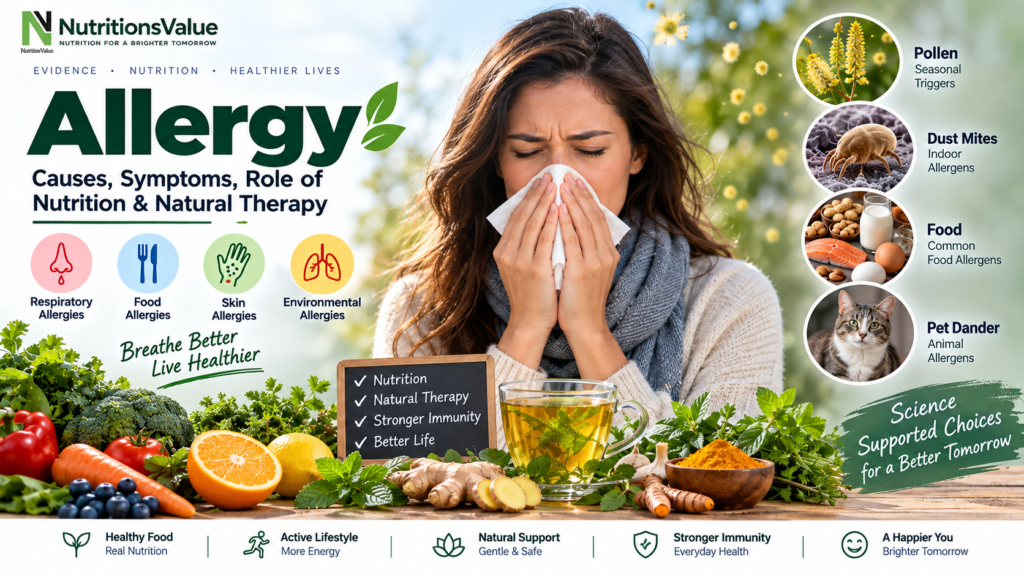
Allergies are among the most common immune related conditions worldwide. They can affect the nose, eyes, skin, lungs, digestive system and, in severe cases, the entire body. Common triggers include pollen, dust mites, mold, animal dander, foods, insect venom and certain medicines.
Nutrition and lifestyle can play an important supportive role in allergy management. A balanced diet can help maintain nutritional health, while appropriate lifestyle measures can reduce exposure to certain environmental triggers. Some natural approaches, such as saline nasal irrigation, have evidence for symptom relief in particular conditions. Herbal remedies have also been used traditionally, but the strength of scientific evidence varies widely.
The most important principle is that natural therapy should complement appropriate medical care rather than replace it, especially when symptoms are severe, persistent or rapidly worsening.
Quick Answer
An allergy occurs when the immune system reacts excessively to an otherwise harmless substance called an allergen.
Common allergens include:
- Pollen
- Dust mites
- Mold
- Animal dander
- Certain foods
- Insect venom
- Medicines
- Latex and some contact substances
Common symptoms include sneezing, runny or blocked nose, itchy or watery eyes, skin itching, hives, swelling, coughing and wheezing. Food allergies may also cause gastrointestinal symptoms.
Nutrition does not provide a universal cure for allergies. Instead, its role is to maintain a balanced diet, prevent unnecessary nutritional deficiencies and help people safely avoid confirmed food allergens.
Natural approaches may include allergen avoidance, saline nasal irrigation, adequate sleep, physical activity, stress management and selected food-level herbs. Evidence for specific herbal products and supplements is variable, and concentrated herbal preparations can carry risks.
What Is an Allergy?
An allergy is an immune-system reaction to a substance that is usually harmless to most people.
The immune system normally protects the body against potentially harmful organisms and substances. In an allergic person, however, the immune system can identify a normally harmless substance as a threat.
The resulting immune response can involve chemicals such as histamine and other inflammatory mediators.
Depending on the type of allergy, this reaction may affect different parts of the body.
For example:
- Pollen can trigger allergic rhinitis.
- Food allergens can produce skin, digestive or respiratory symptoms.
- Certain substances can cause contact dermatitis.
- Insect venom can produce localized or systemic reactions.
- Some medicines can trigger allergic reactions.
Allergies can be temporary, seasonal, recurrent or persistent.
Common Causes and Triggers of Allergies
Allergies do not usually have one single cause. Genetic susceptibility, immune-system characteristics and environmental exposure can all contribute.
A person with a family history of allergic disease may have a greater tendency toward allergies, although having allergic relatives does not mean that an individual will necessarily develop the same allergies.
Major Allergy Triggers
Allergy trigger | Common examples | Possible symptoms |
Pollen | Trees, grasses, weeds | Sneezing, runny nose, itchy eyes |
Dust mites | Household dust and bedding | Nasal congestion, sneezing, coughing |
Mold | Indoor and outdoor mold spores | Rhinitis, coughing, wheezing |
Animal allergens | Cats, dogs and other animals | Sneezing, itchy eyes, congestion |
Foods | Milk, eggs, peanuts, nuts, fish, shellfish, wheat, soy, sesame | Hives, swelling, vomiting, breathing symptoms |
Insect venom | Bees, wasps and other insects | Swelling, hives, systemic reactions |
Medicines | Certain antibiotics and other medicines | Rash, swelling and potentially severe reactions |
Latex | Gloves and latex-containing products | Skin or systemic reactions |
Contact substances | Cosmetics, fragrances and chemicals | Itching, redness, dermatitis |
Not every person reacts to every allergen. Allergy triggers are highly individual.
Why Do Some People Develop Allergies?
Allergic disease can involve both genetic and environmental factors.
People may be more susceptible because of their genetic background or family history. Environmental exposure can also influence whether allergic symptoms develop.
Other factors may influence the pattern of allergic disease, including:
- Age
- Existing allergic conditions
- Environmental exposure
- Air quality
- Occupational exposure
- Household allergens
- Certain infections or immune factors
It is therefore inaccurate to attribute all allergies to one food, one vitamin deficiency or one lifestyle habit.
Symptoms of Allergy
Allergy symptoms vary depending on the allergen and the part of the body affected.
Nose and Respiratory Symptoms
Common symptoms of allergic rhinitis include:
- Sneezing
- Runny nose
- Stuffy nose
- Nasal itching
- Throat irritation
- Postnasal drainage
- Cough
- Reduced sense of smell
Some people experience seasonal symptoms, while others may have symptoms throughout the year.
Eye Symptoms
Allergies can cause:
- Watery eyes
- Itchy eyes
- Red eyes
- Swelling around the eyes
- Burning or irritation
Skin Symptoms
Possible skin manifestations include:
- Hives
- Itching
- Redness
- Rash
- Swelling
Digestive Symptoms
Some food-related allergic reactions can cause:
- Nausea
- Vomiting
- Abdominal discomfort
- Diarrhea
However, digestive symptoms alone do not automatically prove a food allergy. Food intolerance, infection, gastrointestinal disease and other conditions can produce similar symptoms.
Allergy Symptoms: Mild, Moderate and Severe
Understanding severity is important.
Severity | Examples | Appropriate response |
Mild | Sneezing, mild itching, watery eyes | Avoid trigger and consider appropriate symptom management |
Moderate | Widespread hives, significant swelling, persistent symptoms | Seek medical advice, particularly if symptoms are recurrent |
Severe | Difficulty breathing, throat swelling, fainting, severe dizziness | Emergency medical care immediately |
A reaction that initially appears mild can sometimes progress. People with known severe allergies should follow their healthcare professional’s emergency action plan.
Anaphylaxis: A Medical Emergency
Anaphylaxis is a severe, potentially life-threatening allergic reaction.
Possible warning signs include:
- Difficulty breathing
- Wheezing
- Tightness in the throat
- Swelling of the tongue or throat
- Difficulty swallowing
- Severe dizziness
- Fainting
- Rapidly worsening symptoms
- Widespread hives accompanied by breathing or cardiovascular symptoms
Important
Do not attempt to treat suspected anaphylaxis with herbs, honey, supplements, special foods or home remedies.
If a person has a prescribed epinephrine auto-injector for a known severe allergy, it should be used according to their emergency plan, followed by emergency medical care.
Food Allergy vs Food Intolerance
These terms are frequently confused.
A food allergy involves an immune response to a food component, commonly a protein.
A food intolerance generally involves a different mechanism and does not represent the same type of immune reaction.
For example, lactose intolerance occurs when the body has difficulty digesting lactose because of insufficient lactase activity. This is different from an immune-mediated allergy to milk proteins.
This distinction is important because unnecessary food restriction can reduce dietary variety and potentially cause nutritional deficiencies.
Role of Nutrition in Allergy Management
Nutrition has an important but often misunderstood role.
There is no universal allergy diet that cures all allergies.
Instead, nutrition can help in several ways.
- Maintain nutritional adequacy
A person avoiding an allergenic food still needs sufficient:
- Protein
- Carbohydrates
- Healthy fats
- Fiber
- Vitamins
- Minerals
- Energy
- Fluids
- Replace excluded foods
If someone must avoid milk, eggs, wheat, nuts or another important food group, appropriate alternatives may be needed.
- Support overall health
A varied diet based largely on minimally processed foods can support general nutritional health.
- Prevent unnecessary restriction
People should not eliminate multiple foods simply because they believe those foods might cause allergy symptoms without appropriate evaluation.
Foods That Can Form Part of a Healthy Allergy Friendly Diet
There is no single diet suitable for everyone with allergies. Food choices must be based on individual tolerance.
Food group | Examples | Nutritional contribution |
Vegetables | Broccoli, spinach, carrots, peppers | Fiber, vitamins, minerals, plant compounds |
Fruits | Apples, berries, oranges, guava | Fiber, vitamins, minerals |
Whole grains | Oats, brown rice, barley | Fiber and complex carbohydrates |
Legumes | Lentils, chickpeas, beans | Protein, fiber, minerals |
Protein foods | Poultry, fish, eggs, legumes | Protein and other nutrients |
Dairy or alternatives | Milk, yogurt or suitable alternatives | Protein, calcium and other nutrients |
Seeds | Chia, flax, pumpkin seeds when tolerated | Healthy fats, fiber, minerals |
Healthy fats | Olive oil, avocado and suitable plant oils | Unsaturated fats |
The key is not simply to choose foods labeled “healthy.” The foods must also be safe for the individual’s specific allergy profile.
Food Allergy and Elimination Diets
An elimination diet may be necessary when a particular food allergy has been identified.
However, unnecessarily eliminating many foods can create problems.
For example, eliminating dairy without replacing its nutritional contribution may reduce calcium and protein intake. Eliminating several foods simultaneously can make it even harder to maintain adequate nutrition.
Therefore:
The goal is to eliminate the allergen while preserving dietary quality and nutritional diversity.
People with multiple food allergies may benefit from working with an allergist and registered dietitian.
Can Nutrition Cure Allergies?
No single food or diet has been established as a universal cure for allergies.
This is an important distinction for responsible health content.
Foods containing antioxidants, omega-3 fatty acids, fiber and other nutrients can contribute to a healthy diet. However, this does not mean they eliminate the immune response responsible for an allergy.
Claims such as:
- “This food cures allergies”
- “This detox removes allergens”
- “This herb permanently resets immunity”
- “This diet eliminates allergic reactions”
should be approached with caution.
Good nutrition supports health; it should not be confused with a guaranteed allergy treatment.
The Role of Natural Therapy
Natural therapy is a broad term that can include:
- Trigger avoidance
- Saline nasal irrigation
- Healthy nutrition
- Physical activity
- Sleep
- Stress management
- Herbal preparations
- Probiotics
- Other complementary approaches
The evidence differs considerably between these approaches.
For this reason, NutritionsValue should present natural therapy as supportive care, not as a replacement for proven medical treatment.
Saline Nasal Irrigation
Saline nasal irrigation is one of the better-studied non-drug approaches for allergic rhinitis.
It involves rinsing the nasal passages with a saline solution, which can help remove mucus and environmental particles.
Research suggests that saline nasal irrigation may provide modest improvement in some allergic-rhinitis symptoms.
Safety matters
Do not use untreated tap water in nasal irrigation.
Use appropriately:
- Distilled water
- Sterile water
- Or water that has been appropriately boiled and cooled
The irrigation device should also be cleaned according to its instructions.
Herbal Support for Allergies
Herbs have been used traditionally for respiratory and general wellness purposes for centuries. However, traditional use is not equivalent to clinical proof.
The NutritionsValue herbal reference specifically approaches allergy-related herbal care as supportive care for mild symptoms, while noting that evidence for many homemade herbal preparations is limited.
Potentially relevant food level herbs include:
Ginger
Botanical name: Zingiber officinale
Ginger can be consumed as part of food or as a mild traditional beverage.
It contains bioactive compounds that have been investigated in inflammation-related research.
However, ginger should not be presented as a proven cure for allergic disease.
Tulsi
Botanical name: Ocimum tenuiflorum
Tulsi has a long history of traditional use, particularly in South Asian wellness practices.
It can be consumed in food-level preparations by people who tolerate it, but evidence for treating allergy itself remains insufficient for strong clinical claims.
Turmeric
Botanical name: Curcuma longa
Turmeric contains curcuminoids that have been studied for various biological effects.
Laboratory findings, however, cannot automatically be interpreted as proof that turmeric treats allergies in humans.
Green Tea
Botanical name: Camellia sinensis
Green tea provides catechins and other plant compounds.
It can be part of a healthy dietary pattern for people who tolerate caffeine and tea, but it should not be marketed as a treatment for allergy.
Honey and Seasonal Allergies
Honey is frequently promoted online as a natural remedy for pollen allergies.
The theory is that consuming local honey could expose a person to small quantities of pollen and somehow reduce sensitivity.
However, current evidence does not provide convincing support for honey as a treatment for seasonal allergies.
Honey can still be part of a normal diet for people who tolerate it, but it should not be promoted as an established allergy therapy.
And importantly, honey should not be given to children under one year of age.
Best Exercises and Yogas
- Best Exercises for Nose Allergy
Brisk Walking Best Starting Option
20–30 minutes, 5 days/week
Benefits:
- General cardiovascular fitness
- Stress reduction
- Better sleep
- Supports healthy body weight
- May help overall respiratory fitness
Start with 10–15 minutes if you’re inactive and gradually increase.
Cycling
20–30 minutes, 3–5 days/week
Indoor cycling can be particularly useful during high-pollen periods because it reduces outdoor pollen exposure.
Swimming
Swimming can provide aerobic exercise without outdoor pollen exposure, although some people may be sensitive to chlorine or pool environments.
Light Jogging
If symptoms are well controlled, light jogging can be included.
However, don’t force outdoor exercise during very high pollen exposure, particularly if you also have asthma. Current 2026 EAACI guidance emphasizes personalized pollen-avoidance strategies and the use of pollen forecasts for managing pollen-related respiratory disease.
- Yoga for Nose Allergy
Yoga can be useful as a supportive wellness practice, particularly for relaxation, breathing awareness and general physical activity.
However, don’t claim that yoga removes the underlying allergy.
- Sukhasana
Simple cross-legged sitting.
Duration: 5–10 minutes
Focus on relaxed, comfortable breathing.
- Bhujangasana
Cobra Pose
May be included as part of a general yoga routine for mobility and posture.
It isn’t established as a specific treatment for allergic rhinitis.
- Setu Bandhasana
Bridge Pose
Useful as a general strengthening/mobility exercise.
- Balasana
Child’s Pose
Can be used for relaxation.
If nasal congestion makes breathing uncomfortable, don’t force the position.
- Gentle Cat-Cow
A simple mobility exercise that can be incorporated into a breathing-focused yoga routine.
- Pranayama: Which Ones?
This needs a little more caution.
Diaphragmatic Breathing
One of the safest options.
How:
- Sit comfortably.
- Relax your shoulders.
- Place one hand on the abdomen.
- Breathe gently through the nose if comfortable.
- Allow the abdomen to expand naturally.
- Exhale slowly.
- Continue for 5–10 minutes.
The goal is relaxation and breathing control—not forcing air through a blocked nose.
Nadi Shodhana / Alternate-Nostril Breathing
Can be used as a gentle relaxation practice if the nose is sufficiently open.
Do not forcefully inhale through a completely blocked nostril.
Avoid Forceful Pranayama During Symptoms
I would not recommend aggressive or forceful breathing practices such as very forceful rapid breathing when someone is experiencing significant nasal obstruction, dizziness, wheezing or breathing difficulty.
NCCIH advises beginners to avoid forceful breathing practices in yoga and recommends learning yoga appropriately under qualified guidance.
- Saline Nasal Irrigation More Evidence Than Most “Natural Remedies”
For allergic rhinitis, this is actually one of the better-supported complementary approaches.
A saline rinse can help wash mucus and allergens from the nasal passages.
NCCIH reports evidence that saline nasal irrigation can provide modest improvement in seasonal allergy symptoms, and reviews have found improvements in nasal symptoms and quality of life in some people.
Important Safety Rule
Use:
- Distilled water, or
- Sterile water, or
- Properly boiled and cooled water.
Do not use untreated tap water for nasal irrigation.
Clean the device properly after use.
- Simple Daily Routine for Nose Allergy
You can actually add this as a “Natural Allergy Daily Routine” box in your article.
Time | Activity | Duration |
Morning | Gentle breathing | 5 min |
Morning | Yoga/mobility | 10–15 min |
Morning/evening | Brisk walking | 20–30 min |
Evening | Relaxation breathing | 5–10 min |
During symptoms | Saline nasal irrigation | As appropriate |
Night | Good sleep routine | 7–9 hours for most adults |
The exercise doesn’t need to be intense. Consistency is more important than intensity.
- What About Outdoor Exercise During Pollen Season?
This is especially important for seasonal allergic rhinitis.
If pollen is your trigger:
Better strategy
Check pollen levels before outdoor exercise.
When pollen levels are high:
- Exercise indoors when practical.
- Choose lower-exposure times when appropriate.
- Keep windows closed when necessary.
- Shower/change clothes after prolonged outdoor exposure.
- Avoid exercising in areas with obvious heavy pollen exposure.
The 2026 EAACI guideline specifically supports pollen exposure reduction and personalized use of pollen forecasts for pollen-related allergic rhinitis and asthma.
- Exercise During Severe Symptoms
Don’t force exercise if you have:
- Significant breathing difficulty
- Wheezing
- Chest tightness
- Severe dizziness
- Severe weakness
- A rapidly worsening allergic reaction
Especially if someone has asthma along with allergic rhinitis, exercise should be individualized.
Exercise is supportive not emergency treatment.
- Important Point About Yoga and Allergy
“Yoga may support relaxation, breathing awareness, physical activity and overall well-being in people with allergic rhinitis, but current evidence is not strong enough to consider yoga a standalone treatment for nasal allergy.”
NCCIH notes that complementary approaches for seasonal allergies have varying levels of evidence, with saline irrigation having better support than many other approaches.
Best Natural Support
Approach | Potential role | Evidence/position |
Saline nasal irrigation | May reduce nasal symptoms | Relatively good supportive evidence |
Trigger avoidance | Reduces allergen exposure | Important component of management |
Moderate aerobic exercise | General health; possible symptom benefit | Promising but evidence still limited |
Yoga | Relaxation, mobility, breathing awareness | Supportive; not a cure |
Gentle breathing exercises | Relaxation/breathing control | Supportive wellness practice |
Good sleep | General health and symptom coping | Important lifestyle habit |
Stress management | General well-being | Supportive |
Probiotics | Possible benefit in some people | Inconsistent evidence |
Honey | Often promoted for pollen allergy | No convincing evidence |
Butterbur | Historically studied for hay fever | Safety concerns; not recommended as a casual remedy |
NCCIH specifically describes evidence for saline irrigation as reasonably supportive, while evidence for probiotics is inconsistent and evidence for honey is not convincing; butterbur also has important safety concerns.
Probiotics and Allergy
The relationship between the gut microbiome and immune function is an active area of research.
Probiotics have been studied for conditions including allergic rhinitis.
Some studies have reported potential improvements in symptoms or quality of life, while others have not found meaningful benefits.
One major challenge is that probiotics are not a single standardized treatment. Different strains, doses and formulations can produce different results.
Therefore:
Probiotics should not currently be promoted as a universal cure for allergies.
Allergy-Friendly Lifestyle Habits
Lifestyle management can be particularly useful for environmental allergies.
Reduce dust exposure
Regular cleaning and appropriate household practices can help reduce exposure to dust-related allergens.
Manage mold
Address moisture problems and visible mold rather than simply covering up the smell.
Reduce pollen exposure
During high-pollen periods, some people may benefit from:
- Keeping windows closed when appropriate
- Limiting outdoor exposure during high-pollen periods
- Showering after significant outdoor exposure
- Changing clothes after spending prolonged periods outdoors
Avoid smoke
Tobacco smoke and other respiratory irritants can worsen respiratory discomfort and should be avoided.
Sleep and Allergy Management
Poor sleep can make daily symptoms more difficult to tolerate.
Nasal congestion, itching and coughing may interfere with sleep, creating a cycle of fatigue and reduced daytime functioning.
Helpful sleep habits include:
- Maintaining a regular sleep schedule
- Keeping the bedroom comfortable
- Managing known bedroom allergens
- Addressing persistent nighttime symptoms with a healthcare professional
Sleep is not a cure for allergy, but adequate sleep supports overall health and quality of life.
Physical Activity and Allergies
Most people with allergies can remain physically active.
Regular activity can support:
- Cardiovascular health
- Healthy body composition
- Mood
- Sleep
- Overall physical fitness
However, people who experience exercise-related breathing problems or allergic reactions should seek individualized medical guidance.
Exercise should not be used as a replacement for allergy treatment.
Stress Management
Stress does not cause every allergy, but stress and poor sleep can affect how people experience chronic symptoms.
Useful stress-management strategies may include:
- Walking
- Breathing exercises
- Yoga
- Meditation
- Relaxation techniques
- Spending time outdoors when environmental triggers permit
- Maintaining social connections
These approaches support general well-being rather than directly eliminating the underlying allergy.
Allergy and Weight Management
There is no reliable evidence that losing weight cures allergies.
However, maintaining a healthy body weight can contribute to overall health.
A sensible weight-management approach includes:
- Adequate protein
- High-fiber foods
- Appropriate calorie intake
- Vegetables and fruits
- Regular physical activity
- Adequate sleep
- Sustainable eating habits
People with food allergies should be especially careful with restrictive weight-loss diets because combining allergy-related food avoidance with unnecessary calorie restriction can make nutritional adequacy more difficult.
Allergy, Gut Health and the Immune System
The relationship between the digestive system, gut microbiome and immune system is an important area of scientific research.
A varied diet containing fiber-rich plant foods can support a healthy dietary pattern.
Potentially useful foods, when tolerated, include:
- Vegetables
- Fruits
- Whole grains
- Legumes
- Seeds
- Fermented foods
However, the concept of “healing the gut to cure allergies” goes beyond current evidence.
A healthy gut-supportive diet may contribute to overall health, but it should not be presented as a guaranteed treatment for allergic disease.
Herbs and Supplements: Who Should Be Careful?
Extra caution is appropriate for:
- Pregnant people
- Breastfeeding people
- Children
- Older adults
- People with chronic diseases
- People taking several medications
- People taking blood thinners
- People taking diabetes medicines
- People taking blood pressure medicines
The NutritionsValue herbal reference similarly recommends professional guidance for people in these higher caution groups.
Common Allergy Myths
Myth 1: Herbs can cure every allergy.
Fact: Some herbs have traditional uses and some have been researched, but evidence varies substantially. No universal herbal cure for allergies has been established.
Myth 2: Natural remedies are always safe.
Fact: Herbs and supplements can cause adverse reactions and drug interactions.
Myth 3: Honey prevents pollen allergy.
Fact: Evidence does not convincingly establish honey as an effective treatment for seasonal allergy.
Myth 4: Everyone with allergies needs a restrictive diet.
Fact: Unnecessary restriction can reduce nutritional quality. Dietary avoidance should focus on confirmed or appropriately evaluated allergens.
Myth 5: Losing weight cures allergies.
Fact: Healthy weight management supports overall health but is not a universal allergy treatment.
Myth 6: More herbs mean better results.
Fact: Combining several herbs into concentrated preparations can increase uncertainty and potential risk.
Myth 7: Food intolerance and food allergy are the same.
Fact: They involve different mechanisms and should not automatically be treated in the same way.
When Should You See a Healthcare Professional?
Professional evaluation is recommended when:
- Allergy symptoms repeatedly return.
- Symptoms are persistent.
- Symptoms interfere with sleep or daily life.
- A particular food repeatedly causes symptoms.
- You suspect a medication allergy.
- Symptoms are becoming worse.
- You experience wheezing or breathing difficulties.
- Several foods appear to cause reactions.
- You are unsure whether symptoms represent allergy or intolerance.
A healthcare professional may use medical history, physical examination and appropriate testing to investigate suspected allergies.
When Is Immediate Emergency Care Needed?
Seek emergency medical attention for symptoms suggesting a severe allergic reaction, especially:
- Difficulty breathing
- Severe wheezing
- Throat or tongue swelling
- Difficulty swallowing
- Fainting
- Severe dizziness
- Rapidly worsening symptoms
- Multiple serious symptoms occurring after allergen exposure
Do not wait for a natural remedy to work when anaphylaxis is suspected.
Practical Allergy Management Checklist
Identify the trigger
☐ Record when symptoms occur.
☐ Identify possible environmental exposures.
☐ Note foods associated with reactions.
☐ Discuss recurrent reactions with a healthcare professional.
Reduce exposure
☐ Avoid confirmed food allergens.
☐ Read ingredient labels carefully.
☐ Reduce exposure to known environmental allergens.
☐ Address indoor dust and mold.
Maintain nutrition
☐ Eat a varied diet based on tolerated foods.
☐ Maintain adequate protein.
☐ Include fiber-rich foods.
☐ Replace nutrients from eliminated foods.
Natural/supportive care
☐ Consider evidence-informed supportive measures.
☐ Use food-level herbs cautiously.
☐ Avoid concentrated homemade herbal preparations.
☐ Do not ingest essential oils as home remedies.
Safety
☐ Know the warning signs of anaphylaxis.
☐ Follow your healthcare professional’s allergy action plan.
☐ Keep prescribed emergency medication available when indicated.
FAQs
What causes allergies?
Allergies develop through a combination of immune-system sensitivity, genetic susceptibility and environmental exposure. Common triggers include pollen, dust mites, mold, animal allergens, foods, insect venom and certain medicines.
What are the most common allergy symptoms?
Sneezing, runny or blocked nose, itchy or watery eyes, itching, hives, rash and swelling are common. Some allergic reactions can also produce coughing, wheezing or gastrointestinal symptoms.
Can allergies be treated naturally?
Some natural and complementary approaches may provide supportive symptom relief, depending on the type of allergy. However, there is no universal natural therapy that cures all allergies.
Can ginger cure allergies?
No. Ginger can be consumed as a food-level herb and has been investigated for various biological effects, but it should not be promoted as a proven cure for allergy.
Is turmeric good for allergies?
Turmeric contains biologically active compounds that have been studied in inflammation research. However, this does not establish turmeric as an effective treatment for allergic disease.
Can honey treat seasonal allergies?
Current evidence does not convincingly establish honey as an effective treatment for seasonal allergies.
Can probiotics cure allergies?
No. Probiotics have been investigated for some allergic conditions, but results are inconsistent and depend on the specific formulation and condition.
What foods should I eat if I have an allergy?
Eat a varied, nutritionally adequate diet using foods you safely tolerate. Vegetables, fruits, whole grains, legumes and suitable protein sources can form the foundation of a healthy diet.
Should I eliminate dairy, gluten or sugar if I have allergies?
Not automatically. Eliminating foods without a confirmed reason can unnecessarily restrict the diet. Dietary changes should be based on the specific allergy or medical condition.
Can losing weight cure allergies?
No. Healthy weight management can support overall health, but it should not be presented as a cure for allergic disease.
Is saline nasal irrigation useful?
For allergic rhinitis, saline nasal irrigation may provide modest symptom relief for some people. Safe water and proper device hygiene are essential.
When is an allergy an emergency?
Difficulty breathing, throat or tongue swelling, fainting, severe dizziness or rapidly worsening symptoms can indicate anaphylaxis and require immediate emergency medical attention.
NutritionsValue Bottom Line
Allergies are immune-system reactions to specific substances, not simply the result of poor nutrition or a lack of one particular nutrient. They can involve the nose, eyes, skin, digestive system or respiratory system, and severe reactions can become life-threatening.
The foundation of allergy management is identifying relevant triggers, reducing exposure, following appropriate medical advice and maintaining nutritional adequacy.
Nutrition has an important supporting role. A balanced diet rich in vegetables, fruits, whole grains, legumes and appropriate protein foods can support overall health. People with food allergies should avoid their confirmed allergens while making sure that the nutrients supplied by those foods are replaced through suitable alternatives.
Natural therapy can also have a supporting role. Saline nasal irrigation has evidence for modest symptom improvement in allergic rhinitis, while evidence for herbs, honey, probiotics and other complementary approaches is more variable. Natural products should not automatically be assumed to be safe or effective.
The key message is simple:
Identify the trigger. Reduce exposure. Maintain good nutrition. Use natural approaches carefully. And never allow a home or herbal remedy to delay appropriate medical treatment.
Explore More Healthy Article
🩺 Weight management
🩺 Weight management
🥗 Spinach:Nutrition
🍎 Comparative Analysis of the Most Nutritious Fruits
🌿 Top 10 Herbs
⚖️ Spinach Nutrition
Medical Disclaimer
This article is intended for educational and informational purposes only. It is not a substitute for professional diagnosis, individualized medical advice or emergency treatment. Herbal remedies and supplements may have side effects or interact with medicines. People who are pregnant or breastfeeding, children, older adults, people with chronic diseases, people taking regular medication, and anyone experiencing recurrent or severe allergic reactions should seek appropriate professional guidance.
Suspected anaphylaxis is an emergency and requires immediate medical attention.
References
National Center for Complementary and Integrative Health (NCCIH). Seasonal Allergies and Complementary Health Approaches. NIH.
National Center for Complementary and Integrative Health (NCCIH). 6 Things To Know About Complementary Health Approaches for Seasonal Allergy Relief. NIH.
National Center for Complementary and Integrative Health (NCCIH). Seasonal Allergies at a Glance. NIH.
Hermelingmeier KE, Weber RK, Hellmich M, et al. Nasal irrigation as an adjunctive treatment in allergic rhinitis: a systematic review and meta-analysis. Am J Rhinol Allergy. 2012;26(5):e119-e125.
Feng S, Han M, Fan Y, et al. Acupuncture for the treatment of allergic rhinitis: a systematic review and meta-analysis. Am J Rhinol Allergy. 2015;29(1):57-62.
Zajac AE, Adams AS, Turner JH. A systematic review and meta-analysis of probiotics for the treatment of allergic rhinitis. Int Forum Allergy Rhinol. 2015;5(6):524-532.
Saarinen K, Jantunen J, Haahtela T. Birch pollen honey for birch pollen allergy—a randomized controlled pilot study. Int Arch Allergy Immunol. 2011;155(2):160-166.
Guo R, Pittler MH, Ernst E. Herbal medicines for the treatment of allergic rhinitis: a systematic review. Ann Allergy Asthma Immunol. 2007;99(6):483-495.
National Institute of Allergy and Infectious Diseases (NIAID). Guidelines for the Diagnosis and Management of Food Allergy.
Allergies. U.S. National Library of Medicine. MedlinePlus — Allergies
National Center for Complementary and Integrative Health (NCCIH). Seasonal Allergies and Complementary Health Approaches.
National Center for Complementary and Integrative Health (NCCIH). Seasonal Allergies at a Glance.
National Center for Complementary and Integrative Health (NCCIH). 6 Things To Know About Complementary Health Approaches for Seasonal Allergy Relief.
Hermelingmeier KE, Weber RK, Hellmich M, et al. Nasal irrigation as an adjunctive treatment in allergic rhinitis: a systematic review and meta-analysis. Am J Rhinol Allergy. 2012;26(5):e119–e125.
Feng S, Han M, Fan Y, et al. Acupuncture for the treatment of allergic rhinitis: a systematic review and meta-analysis. Am J Rhinol Allergy. 2015;29(1):57–62.
Zajac AE, Adams AS, Turner JH. A systematic review and meta-analysis of probiotics for the treatment of allergic rhinitis. Int Forum Allergy Rhinol. 2015;5(6):524–532.
Saarinen K, Jantunen J, Haahtela T. Birch pollen honey for birch pollen allergy—a randomized controlled pilot study. Int Arch Allergy Immunol. 2011;155(2):160–166.
Seidman MD, Gurgel RK, Lin SY, et al. Clinical Practice Guideline: Allergic Rhinitis. Otolaryngol Head Neck Surg. 2015;152(1 Suppl):S1–S43.
Hauk L. Treatment of Seasonal Allergic Rhinitis: A Guideline from the AAAAI/ACAAI Joint Task Force on Practice Parameters. Am Fam Physician. 2018;97(11):756–757.