
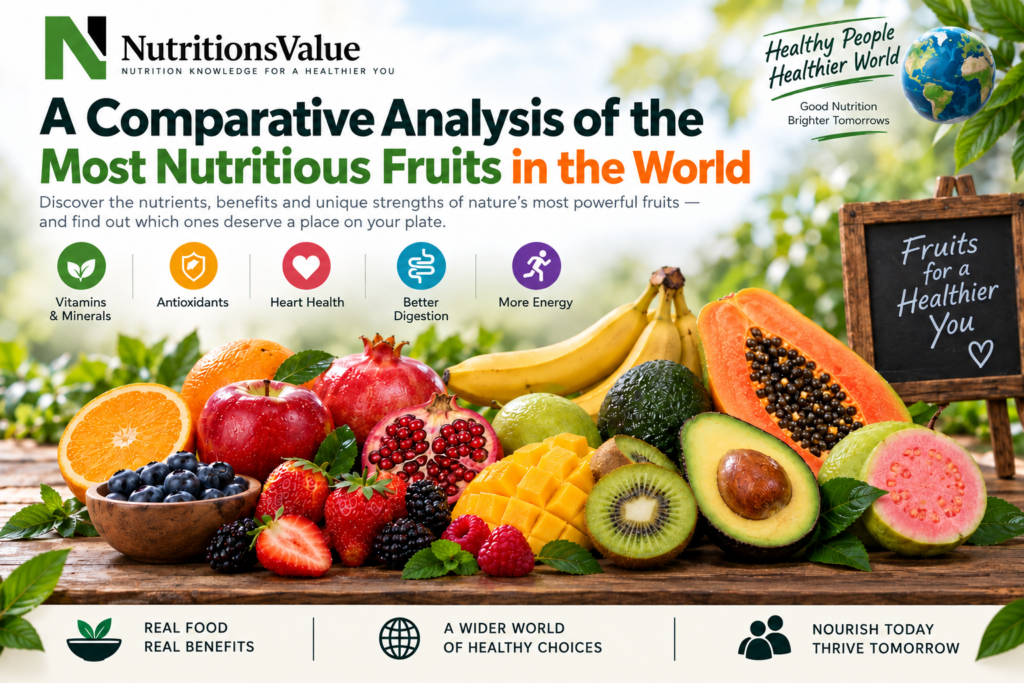
Fruits are among the most nutrient rich foods available in nature. They provide vitamins, minerals, dietary fiber, carbohydrates, water, and a wide variety of naturally occurring plant compounds. Regular fruit consumption is an important part of many healthy dietary patterns, but not all fruits have the same nutritional profile.
Some fruits stand out because they are particularly rich in vitamin C. Others provide substantial amounts of fiber, potassium, folate, carotenoids, healthy fats, or other bioactive compounds. Berries are notable for their high concentration of polyphenols and anthocyanins, while fruits such as guava and kiwi are especially useful sources of vitamin C. Avocado is unusual because, unlike most sweet fruits, it is rich in monounsaturated fat and fiber.
Which fruits are actually the most nutritious, and how do they compare with one another?
There is no scientifically meaningful single winner for everyone. Nutritional value depends on which nutrients or characteristics are being considered. A fruit that is excellent for vitamin C may not be the best source of fiber, while a fruit that provides healthy fats may contain relatively little vitamin C.
This article therefore compares several exceptionally nutrient-dense fruits using multiple criteria rather than simply declaring one fruit the “healthiest.”
The comparison includes:
- Guava
- Kiwi
- Papaya
- Berries
- Avocado
- Oranges
- Pomegranate
- Mango
- Banana
- Apple
The nutritional information discussed in this article should be interpreted as approximate because nutrient composition can vary according to variety, growing conditions, ripeness, preparation and serving size. USDA FoodData Central is one of the major databases used for food composition information and is updated periodically.
What Makes a Fruit "Nutritious"?
Before ranking fruits, it is important to define what nutrition means.
A nutritious fruit can contribute one or more of the following:
- Vitamins
- Minerals
- Dietary fiber
- Naturally occurring carbohydrates
- Healthy fats
- Protein
- Carotenoids
- Polyphenols
- Anthocyanins
- Other phytochemicals
However, nutritional quality cannot be determined by looking at only one nutrient.
For example, a fruit with extremely high vitamin C may still provide less fiber than another fruit. Similarly, avocado contains considerably more fat than most fruits, but much of that fat is monounsaturated and it also provides substantial fiber, potassium, vitamin E, vitamin K and folate. Harvard’s Nutrition Source describes avocado as a nutrient-dense fruit particularly notable for its healthy fats and fiber.
The 10 Most Nutritionally Interesting Fruits
- Guava
Guava deserves a prominent position in any discussion of nutrient-dense fruits.
It is particularly impressive because it combines vitamin C, dietary fiber, folate and several other nutrients in a relatively low-calorie fruit.
Guava is especially notable for its vitamin C content. Depending on variety and database, the amount can be exceptionally high compared with many commonly consumed fruits.
Research conducted through the USDA Agricultural Research Service has also found guava to have high levels of vitamin C, dietary fiber and phenolic compounds compared with several tropical fruits examined in the research.
Why guava stands out
Guava provides:
- Vitamin C
- Dietary fiber
- Folate
- Potassium
- Carotenoids
- Polyphenolic compounds
Its combination of fiber and vitamin C makes it particularly interesting from a nutritional-density perspective.
Guava vs orange
Oranges are widely recognized for vitamin C, but guava can provide substantially more vitamin C per comparable weight.
That does not make oranges nutritionally unimportant.
Oranges provide vitamin C, folate, potassium, water and other plant compounds and are easy to incorporate into everyday diets.
The comparison simply demonstrates why looking beyond familiar fruits can reveal highly nutritious options.
Best way to eat guava
Guava can be eaten:
- Whole
- Sliced
- In fruit salads
- With yogurt
- In smoothies
- As part of traditional preparations
Eating the whole fruit also provides its fiber.
Nutritional verdict
Excellent for: vitamin C, fiber and overall nutrient density.
Potential limitation: availability and variety can differ considerably by region.
- Kiwi
Kiwi is another fruit that performs exceptionally well nutritionally.
It is particularly rich in vitamin C and provides fiber, potassium, vitamin K and other nutrients.
Harvard’s Nutrition Source identifies kiwi among important food sources of vitamin C.
One of kiwi’s advantages is that it combines several nutrients in a relatively small serving.
Its characteristic green flesh also contains various plant compounds, while the seeds contribute additional nutrients.
Kiwi and vitamin C
Vitamin C is essential for normal collagen formation, immune function and several other biological processes.
Fruits and vegetables are among the best dietary sources of vitamin C.
Kiwi therefore represents a useful alternative to citrus fruits for people looking to increase dietary vitamin C.
Kiwi and fiber
Kiwi also contributes dietary fiber.
Fiber is important for digestive health and contributes to a healthy overall eating pattern.
Because kiwi combines fiber with vitamin C, it can be an excellent addition to breakfast or snacks.
How to eat kiwi
Kiwi can be:
- Eaten with a spoon
- Sliced into oatmeal
- Added to yogurt
- Included in fruit salads
- Blended into smoothies
Nutritional verdict
Excellent for: vitamin C, fiber and micronutrient diversity.
Potential limitation: some people may experience oral irritation or allergy-related symptoms.
- Berries
The category “berries” includes several nutritionally impressive fruits, including:
- Blueberries
- Strawberries
- Blackberries
- Raspberries
Berries are especially interesting because of their high concentration of polyphenols and anthocyanins.
Harvard’s School of Public Health describes berries as important sources of vitamins, minerals, fiber and other potentially beneficial compounds.
Harvard also notes that berries provide nutrients including potassium, magnesium, vitamins C and K, fiber and prebiotic compounds.
Blueberries
Blueberries are particularly recognized for anthocyanins, pigments responsible for their deep blue-purple color.
Anthocyanins belong to the larger family of polyphenolic compounds found in many plant foods.
Research has associated diets rich in berries and other plant foods with various health benefits, although it is important not to interpret associations as proof that eating one specific fruit prevents or treats a disease.
Strawberries
Strawberries are notable for vitamin C and provide relatively few calories compared with many other snack foods.
They can also contribute folate, fiber and various polyphenols.
Raspberries
Raspberries are particularly interesting for their fiber content.
Their small seeds and cellular structure contribute to their dietary fiber.
Blackberries
Blackberries provide fiber, vitamin C, vitamin K and anthocyanin-rich pigments.
Fresh vs frozen berries
Frozen berries can also be nutritionally valuable.
Harvard notes that frozen berries can provide health benefits comparable to fresh berries.
This is particularly useful for people living in regions where fresh berries are seasonal or expensive.
Nutritional verdict
Excellent for: polyphenols, anthocyanins, fiber and vitamin C.
Potential limitation: fresh berries can be relatively expensive or less accessible in some regions.
- Avocado
Avocado is perhaps the most unusual fruit in this comparison.
Most fruits are primarily sources of water and carbohydrates. Avocado is substantially different.
It contains considerable amounts of fat, much of which is monounsaturated.
Harvard’s Nutrition Source describes avocado as a source of monounsaturated fat, fiber, vitamin C, vitamin E, vitamin K, folate, potassium, magnesium and carotenoids.
A medium avocado contains approximately 10 grams of fiber and 22 grams of fat according to Harvard’s nutrition information.
Why avocado matters
Avocado demonstrates why “healthy fruit” does not necessarily mean “low-calorie fruit.”
It is relatively energy-dense but provides substantial nutritional value.
Its fat content also makes it particularly useful for meals where additional healthy fat is desired.
Avocado and potassium
Avocado provides significant potassium.
Harvard notes that half of a medium avocado provides about 487 mg of potassium, compared with approximately 422 mg in a medium banana.
Avocado and fiber
Its fiber content makes avocado particularly useful for increasing dietary fiber intake.
Avocado and carotenoids
Avocado contains carotenoids including lutein and zeaxanthin.
These compounds are also found in the human eye and are associated with eye health.
Nutritional verdict
Excellent for: healthy fats, fiber, potassium, vitamin E, vitamin K and folate.
Potential limitation: higher calorie density than most fruits.
- Papaya
Papaya is another highly nutritious tropical fruit.
It provides:
- Vitamin C
- Carotenoids
- Folate
- Fiber
- Potassium
- Vitamin A precursors
Papaya is particularly interesting because of its carotenoid content.
Carotenoids are naturally occurring pigments found in many yellow, orange and red fruits and vegetables.
Harvard identifies papaya as one of the food sources of vitamin C and carotenoids.
USDA-associated research has also examined papaya alongside other tropical fruits and found substantial variation in vitamin C, fiber and phenolic content according to cultivar and ripening stage.
Papaya and vitamin C
Papaya can provide substantial vitamin C.
This makes it particularly useful in tropical diets where it is widely available.
Papaya and carotenoids
The orange color of ripe papaya reflects its carotenoid content.
Some carotenoids can be converted into vitamin A by the body, while others have different biological roles.
Nutritional verdict
Excellent for: vitamin C, carotenoids and overall micronutrient diversity.
Potential limitation: nutritional composition changes with variety and ripeness.
- Pomegranate
Pomegranate is another fruit frequently highlighted for its concentration of polyphenolic compounds.
Its deep red color is associated with pigments and phytochemicals such as anthocyanins.
Pomegranate also provides fiber, vitamin C, vitamin K and folate in varying amounts depending on the edible portion and serving.
One important point is that pomegranate is often consumed as juice.
However, whole pomegranate provides seeds and fiber, while juice removes much of the original fruit structure.
This illustrates a broader principle:
Whole fruit is generally preferable to fruit juice when the goal is to increase fruit intake while retaining fiber and avoiding highly concentrated portions of naturally occurring sugars.
USDA MyPlate specifically encourages people to focus on whole fruits.
Nutritional verdict
Excellent for: polyphenols, anthocyanins and dietary variety.
Potential limitation: juice is easier to overconsume than whole fruit.
- Oranges
Oranges are among the most practical nutritious fruits because they combine nutrition with accessibility.
They provide:
- Vitamin C
- Folate
- Potassium
- Fiber
- Water
- Various plant compounds
Their major nutritional reputation comes from vitamin C.
However, the value of oranges extends beyond vitamin C.
Whole oranges also provide fiber and are naturally portioned.
Orange vs orange juice
This distinction matters.
Whole oranges contain the fruit’s natural structure and fiber.
Juice can still provide nutrients, but it is easier to consume large amounts quickly.
USDA MyPlate recommends choosing whole fruit and provides practical guidance on incorporating whole fruits into meals and snacks.
Nutritional verdict
Excellent for: vitamin C, hydration, fiber and convenience.
Potential limitation: juice is not nutritionally equivalent to whole fruit.
- Mango
Mango is one of the world’s most popular tropical fruits.
It provides:
- Vitamin C
- Carotenoids
- Folate
- Vitamin E in smaller amounts
- Fiber
- Naturally occurring carbohydrates
Mango is especially interesting for its carotenoid content.
Harvard lists mango among foods that contain carotenoids.
Mango and vitamin A precursors
Some mango varieties contain beta-carotene and other carotenoids.
The amount can vary considerably depending on variety and ripeness.
Mango and calories
Mango contains more carbohydrate and natural sugar than some berries.
That does not make mango an unhealthy food.
The appropriate comparison is the entire dietary pattern and serving size.
Whole mango can absolutely fit into a nutritious diet.
Nutritional verdict
Excellent for: vitamin C, carotenoids and dietary variety.
Potential limitation: relatively carbohydrate-dense compared with berries.
- Banana
Bananas are among the most convenient fruits in the world.
They require no preparation, are inexpensive in many countries and can be transported easily.
Nutritionally, bananas provide:
- Carbohydrates
- Potassium
- Vitamin B6
- Fiber
- Manganese
Their carbohydrate content makes them particularly practical around physical activity.
Banana and potassium
Bananas are commonly associated with potassium, although they are not the only excellent dietary source.
Interestingly, Harvard notes that half of a medium avocado contains more potassium than a medium banana.
This is a useful reminder that nutrition claims should be based on comparisons rather than popular reputation.
Banana and exercise
Because bananas provide carbohydrate and are easy to digest for many people, they can be a practical snack before or after physical activity.
However, individual tolerance and activity requirements vary.
Nutritional verdict
Excellent for: convenient carbohydrates, potassium and vitamin B6.
Potential limitation: less vitamin C and polyphenol diversity than several fruits higher on this list.
- Apple
The apple may not have the spectacular vitamin C concentration of guava or the anthocyanin content of berries, but its nutritional importance should not be underestimated.
Apples provide:
- Dietary fiber
- Vitamin C
- Potassium
- Polyphenols
- Naturally occurring carbohydrates
Their greatest advantage may actually be practicality and consistency.
Apples are widely available, portable and easy to store.
Eat the skin?
Apple skin contains fiber and various plant compounds.
When eating apples with the skin, washing them appropriately is important.
The skin also contributes to the fruit’s overall nutritional value.
Nutritional verdict
Excellent for: fiber, convenience and everyday dietary variety.
Potential limitation: lower vitamin C concentration than some tropical fruits and berries.
Comparative Nutrition Table
The following table summarizes the major nutritional strengths of the fruits discussed.
| Fruit | Major Nutritional Strength | Fiber | Vitamin C | Healthy Fats | Carotenoids | Polyphenols |
|---|---|---|---|---|---|---|
| Guava | Vitamin C + fiber | High | Very high | Low | Moderate | High |
| Kiwi | Vitamin C + fiber | High | Very high | Low | Moderate | Moderate |
| Berries | Polyphenols + fiber | High | Moderate–high | Low | Moderate | Very high |
| Avocado | Healthy fats + fiber | Very high | Moderate | Very high | High | High |
| Papaya | Vitamin C + carotenoids | Moderate | High | Low | High | Moderate |
| Pomegranate | Polyphenols | Moderate | Moderate | Low | Moderate | Very high |
| Orange | Vitamin C + hydration | Moderate | High | Low | Moderate | Moderate |
| Mango | Carotenoids + vitamin C | Moderate | Moderate–high | Low | High | Moderate |
| Banana | Potassium + carbohydrate | Moderate | Low–moderate | Very low | Low | Moderate |
| Apple | Fiber + polyphenols | Moderate | Low–moderate | Very low | Low | Moderate |
Important: These are comparative descriptions rather than exact nutrient measurements. Actual nutrient quantities vary by variety, serving size, maturity and preparation. For exact nutrient values, USDA FoodData Central should be consulted.
Which Fruit Has the Most Vitamin C?
If vitamin C is the primary criterion, the competition changes considerably.
Among commonly consumed fruits, guava, kiwi, papaya, oranges and strawberries are particularly useful sources.
Guava stands out strongly.
Papaya and kiwi are also excellent choices.
Oranges are famous for vitamin C but are not necessarily the richest fruit by weight.
This is an important lesson:
The fruit with the strongest reputation for a nutrient is not always the fruit with the highest concentration of that nutrient.
Harvard lists kiwi, strawberries, citrus fruits and papaya among dietary sources of vitamin C.
Which Fruit Has the Most Fiber?
Fiber content varies considerably.
Avocado is particularly notable because it combines substantial fiber with healthy unsaturated fat.
Berries can also provide significant amounts of fiber, particularly raspberries and blackberries.
Guava is another strong candidate.
Apples and pears provide useful amounts of fiber, especially when eaten with their skins.
Therefore, for people specifically trying to increase fiber intake, avocado, berries and guava deserve particular attention.
Which Fruit Has the Most Healthy Fat?
There is an obvious winner:
Avocado
Most fruits contain very little fat.
Avocado is fundamentally different.
Its fat is predominantly monounsaturated, and it also contains fiber, potassium, vitamin E, vitamin K, folate and carotenoids.
This makes avocado nutritionally unique.
However, its higher calorie density means that portion size still matters.
Which Fruit Has the Most Antioxidants?
This question requires caution.
There is no universally accepted ranking of “antioxidant fruits” because antioxidant capacity can be measured in different ways, and laboratory antioxidant tests do not necessarily translate directly into human health outcomes.
Berries are particularly rich in polyphenolic compounds and anthocyanins. Harvard highlights berries as sources of several disease-fighting nutrients and plant compounds.
Guava has also shown impressive levels of vitamin C and phenolic compounds in research on tropical fruits.
Pomegranate is another fruit frequently studied for its polyphenolic compounds.
Rather than searching for a single “antioxidant champion,” it is better to consume a variety of colorful fruits.
Which Fruit Is Best for Heart Health?
There is no single fruit that should be described as a guaranteed heart-health food.
Instead, dietary patterns matter.
Fruits contribute fiber, potassium and plant compounds that can fit into heart-supportive dietary patterns.
Avocado has attracted particular research interest because of its monounsaturated fats and other nutrients.
Harvard reported on a large observational study in which people consuming two or more servings of avocado per week had a lower risk of cardiovascular disease, while also noting that observational studies cannot establish that avocado itself caused the lower risk.
Berries are also frequently included in discussions of heart-supportive dietary patterns.
The broader lesson is more important than choosing a single fruit:
A diverse diet containing many types of fruits and vegetables is more valuable than relying on one “superfood.”
Which Fruit Is Best for Weight Management?
Again, there is no single universal winner.
Many whole fruits have relatively high water content and provide fiber, which can contribute to fullness.
Berries are often useful because they provide substantial flavor and nutrients for relatively few calories.
Apples and oranges are also convenient whole-fruit choices.
Avocado is nutritionally excellent but considerably more calorie-dense because of its fat content.
That does not make avocado unsuitable for weight management. It simply means that portion size may be more relevant.
The broader principle is:
Choose whole fruits and consider the overall energy density and dietary pattern.
Harvard’s Healthy Eating guidance emphasizes overall diet quality rather than focusing on isolated foods.
Which Fruit Is Best for Children?
Children need nutrient-rich foods, but the “best” fruit will depend on age, dietary needs, availability, texture preferences and potential allergies.
Good options include:
- Banana
- Apple
- Orange
- Mango
- Papaya
- Berries
- Kiwi
- Guava
The most important strategy is variety.
Children can benefit from becoming familiar with different flavors, textures and colors.
Parents should also consider choking risks appropriate to the child’s age and developmental stage.
Which Fruit Is Best for Older Adults?
Older adults may benefit from fruits that are:
- Easy to chew
- Fiber-rich
- Nutrient-dense
- Convenient
- Hydrating
Examples include:
- Papaya
- Banana
- Berries
- Kiwi
- Orange
- Avocado
However, individual medical conditions and dietary requirements can change recommendations.
For people with specific medical conditions, medications or dietary restrictions, personalized advice from a qualified healthcare professional may be appropriate.
Whole Fruit vs Fruit Juice
One of the most important conclusions from this comparison is that whole fruit and fruit juice should not automatically be treated as equivalent.
Whole fruits retain their natural structure and fiber.
Juice can concentrate naturally occurring sugars and makes it easier to consume large quantities quickly.
USDA’s MyPlate guidance specifically encourages people to focus on whole fruits and provides practical suggestions such as eating fruit at breakfast, using fruit as a snack and adding fruit to meals.
For most everyday eating situations, whole fruit is therefore the more useful default.
Fresh vs Frozen Fruit
Fresh fruit is excellent, but frozen fruit should not be ignored.
Frozen berries, for example, can be particularly practical when fresh berries are expensive or unavailable.
Harvard notes that frozen berries can provide benefits comparable to fresh berries.
Frozen fruit can also reduce food waste because it can be stored for longer.
However, consumers should distinguish plain frozen fruit from products containing substantial added sugars.
Are Dried Fruits as Healthy as Fresh Fruits?
Dried fruits can provide fiber, minerals and other nutrients.
However, removing water makes them much more concentrated.
For example, it is easier to eat a large quantity of raisins or dates than the equivalent quantity of fresh grapes or fresh dates by weight.
Therefore, portion size matters.
Dried fruit can be part of a healthy diet, but it should not automatically be treated as nutritionally interchangeable with fresh fruit.
The Importance of Fruit Variety
Perhaps the most important conclusion from this entire comparison is that variety beats obsession with a single “superfruit.”
Harvard’s Nutrition Source explicitly states that no single fruit or vegetable provides all the nutrients needed for health and recommends eating a variety of types and colors.
This means a better fruit strategy is:
Red + orange + yellow + green + blue/purple + different textures + different fruit families.
For example, a weekly rotation might include:
- Guava
- Banana
- Orange
- Papaya
- Apple
- Berries
- Mango
- Kiwi
This provides a broader nutritional profile than eating only one fruit every day.
A Practical Ranking by Nutritional Strength
Rather than giving one absolute ranking, we can rank the fruits according to specific strengths.
Best for Vitamin C
- Guava
- Kiwi
- Papaya
- Strawberries
- Oranges
Best for Fiber
- Avocado
- Raspberries
- Blackberries
- Guava
- Apple
Best for Healthy Fats
- Avocado
- Other fruits are far behind
Best for Polyphenols
- Berries
- Pomegranate
- Guava
- Other deeply colored fruits
Best for Carotenoids
- Papaya
- Mango
- Avocado
- Other yellow/orange fruits
Best for Convenience
- Banana
- Apple
- Orange
- Guava
- Kiwi
Best for Overall Nutrient Density
A reasonable group of leading candidates would be:
Guava, berries, kiwi, avocado and papaya.
But this should not be interpreted as a scientific “top five” ranking. Each has a different nutritional strength.
So, What Is the Most Nutritious Fruit in the World?
If we absolutely had to choose one fruit based on the combination of vitamin C, fiber, micronutrients and phytochemicals, guava would be one of the strongest candidates.
However, declaring guava the universally “healthiest fruit in the world” would be misleading.
Why?
Because avocado wins in healthy fats and fiber.
Berries excel in polyphenols and anthocyanins.
Kiwi performs exceptionally well for vitamin C and fiber.
Papaya provides vitamin C and carotenoids.
Banana offers convenient carbohydrate and potassium.
Oranges provide vitamin C, hydration and accessibility.
Pomegranate provides a distinctive polyphenol profile.
Mango contributes carotenoids and vitamin C.
Apples offer fiber, convenience and dietary variety.
Therefore, the scientifically stronger conclusion is:
There is no single healthiest fruit. The healthiest fruit strategy is a diverse combination of nutrient-rich fruits.
Final Verdict
The world’s most nutritious fruits are not necessarily the most exotic or expensive ones.
Some of the strongest nutritional performers are surprisingly accessible.
Guava stands out for vitamin C, fiber and overall nutrient density.
Kiwi combines vitamin C, fiber and several micronutrients.
Berries provide an impressive variety of polyphenols, anthocyanins, vitamins and fiber.
Avocado is unique among fruits because it supplies substantial monounsaturated fat, fiber, potassium and several micronutrients.
Papaya combines vitamin C with carotenoids.
Pomegranate is particularly interesting for its polyphenolic compounds.
Oranges remain an excellent everyday source of vitamin C and are widely accessible.
Mango provides vitamin C and carotenoids while contributing natural sweetness.
Bananas are convenient sources of carbohydrate, potassium and vitamin B6.
Apples provide fiber, plant compounds and exceptional convenience.
Ultimately, the best approach is not to ask:
“Which one fruit should I eat?”
Instead, ask:
“How can I eat a variety of fruits throughout the week?”
A colorful fruit plate containing guava, berries, papaya, kiwi, orange, mango, banana and apple can provide a much broader nutritional spectrum than repeatedly relying on one fruit.
Modern nutrition increasingly emphasizes dietary patterns rather than individual “superfoods.” Harvard’s nutrition guidance similarly stresses overall diet quality and variety, while USDA guidance encourages whole fruits as part of a varied eating pattern.
The real nutritional winner, therefore, is not one fruit.
It is fruit diversity.
Key Takeaways
- Guava is an exceptional source of vitamin C and fiber.
- Kiwi combines vitamin C, fiber and micronutrients.
- Berries are particularly rich in polyphenols and anthocyanins.
- Avocado is unique for its healthy fats and high fiber content.
- Papaya provides vitamin C and carotenoids.
- Pomegranate is rich in diverse plant compounds.
- Oranges are practical sources of vitamin C and fiber.
- Mango provides carotenoids and vitamin C.
- Bananas provide convenient carbohydrates and potassium.
- Apples provide fiber and are highly convenient.
- Whole fruit is generally a better everyday choice than relying heavily on juice.
- Fresh and frozen fruits can both be valuable.
- Dried fruits can be nutritious but are more concentrated.
- No single fruit provides every nutrient the body needs.
- Eating a variety of fruits is more important than finding one “superfruit.”
For exact nutrient quantities, food composition databases such as USDA FoodData Central should be used because nutrient values vary by cultivar, serving size, maturity and preparation.
What would you like to explore next?
🍎Comparative Analysis of the Most Nutritious Fruits in the World
🥬 Explore Iron-Rich Foods
📊 Check Spinach Nutrition
🥗 Explore Healthy Vegetables
📧 Get weekly nutrition insights