
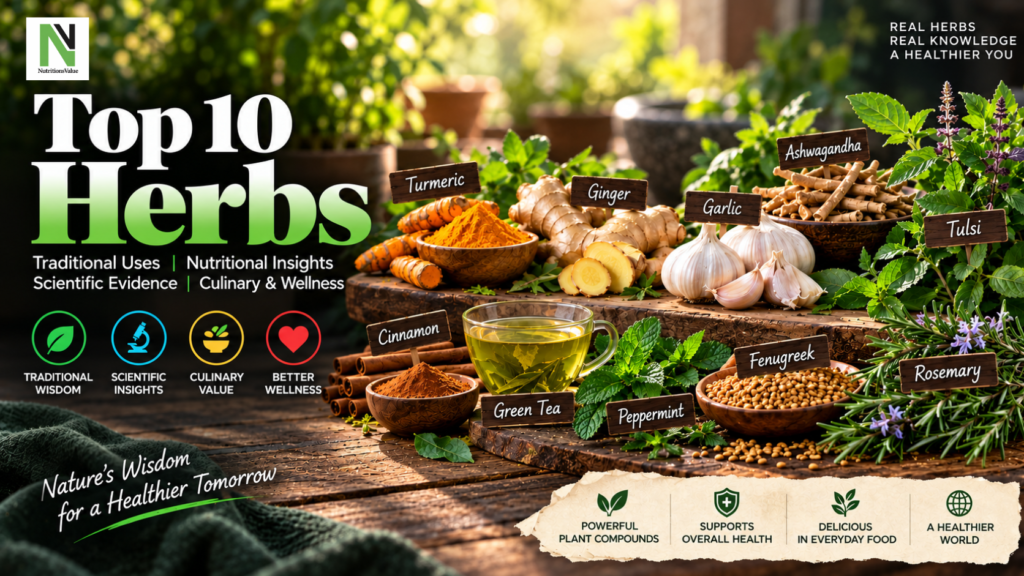
Herbs have been used by human societies for thousands of years not only as medicines in traditional systems, but also as foods, spices, teas, preservatives, fragrances, and everyday culinary ingredients. Modern science has increasingly investigated many of these plants to understand their nutritional composition, phytochemicals, biological mechanisms, potential benefits, and safety.
A herb may have extensive laboratory research but limited human evidence, while another may have centuries of traditional use but relatively little modern clinical research. Therefore, a meaningful comparison should consider several dimensions: traditional importance, nutritional and phytochemical interest, volume of scientific research, human evidence, culinary relevance, and wellness applications.
This article examines ten globally important herbs and herb like culinary botanicals: turmeric, ginger, garlic, ashwagandha, holy basil (tulsi), cinnamon, green tea, peppermint, fenugreek, and rosemary. The term “herb” is used here broadly to include culinary and medicinal botanicals commonly discussed in herbal nutrition.
Scientific note: Traditional use does not automatically prove clinical effectiveness. Laboratory findings, animal studies, observational research, and randomized clinical trials provide different levels of evidence. Throughout this article, potential benefits are described conservatively rather than as disease cures.
Quick Comparison: Top 10 Herbs
Herb | Scientific name | Major phytochemical interest | Research volume | Culinary relevance |
Turmeric | Curcuma longa | Curcuminoids, curcumin, volatile oils | Very high | High |
Ginger | Zingiber officinale | Gingerols, shogaols, zingerone | Very high | Very high |
Garlic | Allium sativum | Allicin and organosulfur compounds | Very high | Very high |
Ashwagandha | Withania somnifera | Withanolides | High and growing | Low–moderate |
Tulsi | Ocimum tenuiflorum | Eugenol, polyphenols, essential oils | Moderate/emerging | Moderate |
Cinnamon | Cinnamomum spp. | Cinnamaldehyde, polyphenols | High | Very high |
Green tea | Camellia sinensis | Catechins, EGCG, caffeine | Very high | Very high |
Peppermint | Mentha × piperita | Menthol, menthone | Moderate | High |
Fenugreek | Trigonella foenum-graecum | Galactomannan, diosgenin, trigonelline, 4-hydroxyisoleucine | Moderate–high | Very high in South Asian cuisine |
Rosemary | Salvia rosmarinus | Rosmarinic acid, carnosic acid, carnosol | High phytochemical research | High |
Research-volume ratings are qualitative, reflecting the breadth of published scientific literature rather than an official ranking or a simple PubMed count.
- Turmeric – Curcuma longa
Traditional use
Turmeric is one of the most culturally important medicinal and culinary plants originating from South Asia. Its rhizome has long been used in Indian and other Asian food traditions, while traditional medical systems have employed turmeric in a variety of preparations.
Its bright yellow-orange color comes largely from curcuminoids, a group of polyphenolic compounds dominated by curcumin.
Nutritional and phytochemical interest
Turmeric is particularly interesting scientifically because it contains:
- Curcumin
- Demethoxycurcumin
- Bisdemethoxycurcumin
- Volatile oils
- Turmerones and related compounds
Curcumin has attracted enormous research interest because laboratory and mechanistic studies suggest antioxidant and anti-inflammatory activities.
The scale of modern research is substantial. A 2024 systematic review and meta-analysis included 103 randomized controlled trials involving 7,216 participants and 42 health outcomes. The researchers found statistically significant effects for some outcomes, but evidence quality varied considerably, and they emphasized the need for larger, better-designed long-term trials.
Culinary use
Turmeric is widely used in:
- Curries
- Dal
- Vegetable preparations
- Rice dishes
- Pickles
- Golden milk
- Spice blends
- Soups and sauces
Importantly, culinary turmeric and concentrated curcumin supplements are not equivalent exposures.
Wellness perspective
Turmeric is scientifically interesting, particularly for research involving inflammatory and metabolic pathways. But it should not be presented as a cure for arthritis, cancer, diabetes, or other diseases.
- Ginger – Zingiber officinale
Traditional use
Ginger is one of the world’s most widely used culinary and traditional medicinal plants. Its rhizome has been used historically for digestive discomfort, nausea, respiratory complaints, and other conditions. NCCIH notes that ginger has been used in folk medicine since ancient times.
The characteristic compounds of ginger include:
- Gingerols
- Shogaols
- Zingerone
- Essential oils
- Other phenolic compounds
The concentration and composition of these compounds can change depending on whether ginger is fresh, dried, heated, or processed.
Research volume
Ginger has a particularly large human research base. One comprehensive systematic review identified 109 randomized controlled trials investigating ginger across different health outcomes. Evidence was relatively consistent for some areas, including nausea and vomiting, while other applications remained controversial.
Another overview identified 27 systematic reviews, with nausea and vomiting being the most extensively reviewed area.
NCCIH reports that research suggests ginger may help with nausea associated with pregnancy, although findings differ depending on the condition and preparation.
Ginger is exceptionally versatile:
- Ginger tea
- Curries
- Stir-fries
- Soups
- Pickles
- Marinades
- Chutneys
- Baked goods
- Beverages
Wellness perspective
Among traditional botanicals, ginger is notable because its culinary use and human research base overlap strongly. Eating ginger as a food is different from taking concentrated extracts.
Large amounts or supplements can cause abdominal discomfort, heartburn, diarrhea, or mouth irritation in some people.
- Garlic – Allium sativum
Traditional use
Garlic has been cultivated and consumed around the world for centuries. Historical records from civilizations including Egypt, Greece, and India describe its use as both food and a traditional remedy.
Phytochemical interest
Garlic is particularly interesting because of its organosulfur compounds.
One of the best-known compounds is allicin, which can form when garlic tissue is damaged, such as through chopping or crushing.
Other sulfur-containing compounds contribute to garlic’s characteristic aroma and biological activity.
Research volume
Garlic has an extensive research literature, particularly concerning cardiovascular risk factors.
A 2026 systematic review and meta-analysis included 108 randomized controlled trials involving 7,137 participants. It reported improvements in several cardiovascular and metabolic markers, although the authors emphasized the need for larger studies, longer follow-up, and stronger methodology.
NCCIH similarly notes that garlic supplements may produce small reductions in total and LDL cholesterol, while evidence for blood pressure and blood glucose effects is more limited.
Culinary role
Garlic is one of the most important flavoring ingredients worldwide and appears in:
- Curries
- Pasta
- Sauces
- Soups
- Pickles
- Stir-fries
- Roasted vegetables
- Meat and seafood dishes
- Chutneys
Wellness perspective
Garlic demonstrates an important principle in nutritional science: a food can be nutritionally interesting without being a medicine.
Garlic supplements may also increase bleeding risk, particularly when combined with anticoagulants or certain medications.
- Ashwagandha – Withania somnifera
Traditional use
Ashwagandha is an important plant in Ayurvedic traditions and has been used for thousands of years. It is native to regions including India, Africa, and the Middle East.
Traditionally, different preparations have been used in the context of vitality, stress, sleep, and general wellness.
Phytochemical interest
The most distinctive compounds are withanolides, steroidal lactones that have become the focus of extensive laboratory and clinical research.
Unlike turmeric, ginger, and garlic, ashwagandha is less important as an everyday culinary spice and more commonly encountered in herbal preparations and dietary supplements.
Research volume
Research has expanded significantly in recent years.
NCCIH reports that many clinical trials have examined ashwagandha, although studies often involve small sample sizes and different preparations, making direct comparison difficult. Some preparations may help with stress and insomnia, but evidence for anxiety and many other proposed applications remains uncertain.
A 2026 systematic review and dose-response meta-analysis specifically evaluated randomized controlled trials of ashwagandha for mental-health outcomes, reflecting the continuing expansion of clinical research in this area.
Culinary and wellness use
Ashwagandha is sometimes incorporated into:
- Herbal beverages
- Powders
- Traditional preparations
- Milk-based drinks
- Supplement formulations
Safety
This is one herb where “natural” should not be confused with “risk-free.”
NCCIH states that short-term use may be safe for some adults, but long-term safety is unclear. Reported adverse effects include gastrointestinal symptoms and drowsiness, and rare cases of liver injury have been reported. It is also not recommended during pregnancy and may interact with several medications and medical conditions.
- Holy Basil or Tulsi – Ocimum tenuiflorum
Traditional importance
Tulsi, commonly called holy basil, has deep cultural and medicinal significance in South Asia. It has been used in Ayurvedic and Siddha traditions for generations.
Unlike many Western culinary herbs, tulsi has a particularly strong connection with traditional Indian wellness practices.
Phytochemical interest
Tulsi contains numerous plant compounds, including:
- Eugenol
- Phenolic compounds
- Flavonoids
- Essential oils
- Terpenoid compounds
The exact phytochemical profile can vary according to plant variety, growing conditions, and preparation.
Scientific research
Compared with ginger, garlic, turmeric, and green tea, tulsi has a smaller clinical evidence base.
A systematic review of human studies identified 24 studies reporting clinical outcomes involving tulsi. The authors concluded that the research was promising but that further studies were required to clarify mechanisms, doses, preparations, and populations most likely to benefit.
Culinary and wellness use
Tulsi can be used as:
- Herbal tea
- Fresh leaves in beverages
- Infusions
- Traditional preparations
- Aromatic culinary herb
Scientific perspective
Tulsi is a good example of why traditional popularity and research volume should be separated. Its traditional significance is enormous, but modern clinical evidence remains considerably smaller than the evidence base for ginger, garlic, turmeric, or green tea.
- Cinnamon – Cinnamomum Species
Traditional use
Cinnamon is one of the world’s most recognizable aromatic spices. It has been used historically in food, beverages, traditional medicine, and perfumery.
Commercial cinnamon comes from several Cinnamomum species, including varieties commonly referred to as Ceylon cinnamon and cassia cinnamon.
Phytochemicals
Important compounds include:
- Cinnamaldehyde
- Polyphenols
- Procyanidins
- Essential oils
The phytochemical composition differs substantially among cinnamon species.
Research volume
Cinnamon has generated considerable research, especially around glucose metabolism.
A 2024 systematic review examining cinnamon and glucose included 45 studies and evaluated study quality and risk of bias. The authors concluded that cinnamon may have a modest positive effect on blood glucose, but heterogeneity among studies limited the certainty of conclusions.
This is important because internet articles frequently claim that cinnamon can “control diabetes.” Scientific evidence does not justify replacing diabetes treatment with cinnamon.
Culinary applications
Cinnamon is used in:
- Tea
- Coffee
- Desserts
- Baked foods
- Curries
- Rice dishes
- Spice blends
- Breakfast cereals
- Traditional beverages
Its culinary relevance is arguably one of its greatest strengths.
- Green Tea – Camellia sinensis
Why green tea belongs on the list
Green tea is technically not a conventional culinary herb like rosemary or mint. It is the processed leaf of Camellia sinensis. However, it is one of the world’s most important botanical beverages and has an enormous nutrition and phytochemistry research base.
Tea cultivation in China dates back thousands of years, and tea has a long history of use for health and wellbeing.
Phytochemical profile
Green tea contains:
- Catechins
- EGCG
- Caffeine
- Theanine
- Polyphenols
- Volatile compounds
- Minerals and trace elements
NCCIH notes that tea contains polyphenols, alkaloids, amino acids, carbohydrates, proteins, chlorophyll, volatile compounds, fluoride, and minerals.
Research volume
Green tea has one of the largest research literatures among plant-based beverages.
A meta-analysis of 31 randomized trials involving 3,321 participants found reductions in total and LDL cholesterol with green tea consumption, although further research was recommended.
NCCIH, however, emphasizes that definite conclusions cannot yet be reached for many of the health claims made about green tea.
Culinary and lifestyle use
Green tea is consumed as:
- Hot tea
- Iced tea
- Matcha
- Culinary ingredient
- Tea-based beverages
Beverage versus extract
This distinction is extremely important.
Drinking green tea is not equivalent to taking concentrated green tea extract capsules.
NCCIH reports that ordinary beverage consumption has not raised the same safety concerns as concentrated extracts, while rare liver injury has been associated primarily with extract products.
- Peppermint – Mentha piperita
Traditional use
Peppermint is a hybrid mint originating from the water mint and spearmint group. Mint plants have a long history of use for digestive complaints, including in ancient Greek, Roman, and Egyptian traditions.
Phytochemical profile
Peppermint’s characteristic compounds include:
- Menthol
- Menthone
- Menthyl acetate
- Various volatile oils
Menthol is largely responsible for peppermint’s characteristic cooling sensation and aroma.
Research volume
Peppermint has a moderate clinical research base, with most research focusing on peppermint oil rather than ordinary peppermint leaves.
A 2022 meta-analysis identified 10 randomized controlled trials involving 1,030 people with IBS. Peppermint oil performed better than placebo for some IBS outcomes, but adverse events were also more common and the overall quality of evidence was considered very low.
NCCIH similarly states that enteric-coated peppermint oil may provide modest short-term relief of IBS symptoms, while evidence for peppermint leaf itself is much more limited.
Culinary use
Peppermint is commonly used in:
- Herbal tea
- Chutneys
- Desserts
- Salads
- Sauces
- Beverages
- Confectionery
Safety
Peppermint oil is highly concentrated and should not be treated like fresh mint leaves. It may worsen reflux or heartburn in some people.
- Fenugreek – Trigonella foenum graecum
Traditional and culinary importance
Fenugreek is particularly important in South Asian, Middle Eastern, and Mediterranean food traditions. Both the seeds and leaves are used.
In India, methi leaves and seeds are common culinary ingredients, while fenugreek has also been used traditionally for digestive, metabolic, lactation-related, and other purposes.
Nutritional and phytochemical interest
Fenugreek is unusual because it combines nutritional and phytochemical importance.
Its seeds contain:
- Dietary fiber
- Protein
- Galactomannan
- Saponins
- Diosgenin
- Trigonelline
- 4-hydroxyisoleucine
A scientific review identifies diosgenin, 4-hydroxyisoleucine, and the plant’s fiber fraction as among its most extensively studied bioactive components.
Research volume
Fenugreek has a growing clinical research literature, especially regarding glucose metabolism.
A 2023 meta-analysis included 14 trials involving 894 participants and found potential improvements in some glycemic measures, while also noting concerns about study quality and heterogeneity.
Another systematic review and meta-analysis included 10 studies with 706 participants and reported reductions in fasting glucose, post-meal glucose, and HbA1c, although these findings should not be interpreted as proof that fenugreek treats diabetes.
A more recent meta-analysis identified 26 randomized controlled trials and again reported improvements in several glycemic parameters while calling for higher-quality research.
Culinary use
Fenugreek can be used as:
- Methi leaves
- Methi seeds
- Spice blends
- Curries
- Pickles
- Flatbreads
- Dal
- Vegetable dishes
- Herbal preparations
Fenugreek therefore occupies an unusual position between food, spice, traditional herb, and research subject.
- Rosemary – Salvia rosmarinus
Traditional and culinary use
Rosemary is strongly associated with Mediterranean cuisine and has traditionally been used as an aromatic herb and food preservative.
It is particularly valuable from a food-science perspective because its phytochemicals have been investigated for antioxidant and antimicrobial properties.
Phytochemical interest
Important compounds include:
- Rosmarinic acid
- Carnosic acid
- Carnosol
- Flavonoids
- Phenolic acids
- Essential oils
A review of rosemary phytochemistry identified substantial research interest in compounds such as carnosic acid, carnosol, rosmarinic acid, and rosemary essential oil.
Another review notes that rosemary’s biological properties are strongly associated with its phenolic compounds and that rosemary extracts have been studied for antioxidant and antimicrobial properties.
Research volume
Rosemary has a substantial phytochemical and laboratory research literature, although its human clinical evidence base is not comparable to the extensive clinical research surrounding green tea, ginger, garlic, or turmeric.
Culinary use
Rosemary works particularly well with:
- Roasted potatoes
- Vegetables
- Bread
- Soups
- Beans
- Chicken
- Meat
- Marinades
- Olive oil
Its aromatic compounds also make rosemary interesting to the food industry as a potential natural preservative.
How Do These Herbs Compare Scientifically?
A simple “number one to number ten” ranking can be misleading.
Instead, the herbs can be divided according to their strongest scientific characteristics.
Highest research volume
Turmeric, ginger, garlic and green tea stand out for the breadth of human research.
For example, research syntheses have included:
- 103 RCTs for curcumin
- 109 RCTs for ginger
- 108 RCTs in a 2026 garlic cardiovascular meta-analysis
- 31 RCTs in a green-tea lipid meta-analysis
These numbers should not be interpreted as proof that one herb is healthier than another. Different researchers ask different questions, and studies vary in size, formulation, dose, duration, and quality.
Strongest culinary importance
Ginger, garlic, turmeric and cinnamon are particularly successful examples of plants that are simultaneously:
- Food ingredients
- Flavoring agents
- Traditional botanicals
- Subjects of modern scientific research
Strongest phytochemical interest
Turmeric, rosemary, green tea, garlic and fenugreek are particularly notable for their bioactive compounds.
Strongest traditional wellness identity
Ashwagandha and tulsi have especially strong identities within traditional Indian systems, although their modern clinical evidence base is smaller than that of several culinary botanicals.
Traditional Use vs Scientific Evidence
One of the most important concepts in herbal nutrition is understanding the difference between traditional use and clinical evidence.
Traditional use can tell researchers:
- Which plants deserve investigation
- Which plant parts have historically been used
- How plants have been prepared
- How they have been incorporated into diets
- Which wellness effects were traditionally observed
But tradition alone cannot establish that an herb treats a disease.
Scientific evidence usually develops through a hierarchy:
Traditional observation → laboratory research → animal research → observational studies → randomized clinical trials → systematic reviews/meta-analyses
Each stage answers different questions.
For example, a compound may show antioxidant activity in a laboratory experiment but produce little measurable effect in humans because its absorption, metabolism, dose, or biological availability differs.
That is why evidence-based nutrition should avoid phrases such as:
“This herb cures disease.”
Instead, scientifically responsible language includes:
- “Research has investigated…”
- “Evidence suggests…”
- “Some studies have reported…”
- “Potential benefits have been observed…”
- “Human evidence remains limited…”
- “More high-quality trials are needed.”
Herbs Are Not Automatically Safe
Another important misconception is that natural means harmless.
Herbal products can contain pharmacologically active substances. Their effects can depend on:
- Dose
- Preparation
- Plant part
- Extraction method
- Standardization
- Individual health status
- Medications
- Duration of use
For example, NCCIH reports potential medication interactions and safety concerns for several herbs discussed in this article. Garlic supplements may increase bleeding risk; green-tea extracts have been associated with rare liver injury; and ashwagandha has specific safety concerns and medication interactions.
This is particularly important when comparing foods with concentrated supplements.
A teaspoon of a culinary spice incorporated into food is not necessarily equivalent to a concentrated standardized extract containing a much higher amount of particular compounds.
How to Include Herbs in a Healthy Diet
For most people, the most practical approach is to treat culinary herbs and spices as components of an overall healthy dietary pattern, rather than as replacements for medical treatment.
You can incorporate herbs through:
Everyday cooking
Use turmeric, ginger, garlic, cinnamon, rosemary, mint, and fenugreek to increase flavor without relying exclusively on large amounts of salt, sugar, or heavy sauces.
Herbal beverages
Green tea, ginger tea, peppermint tea, and tulsi infusions can provide variety in beverage choices.
Whole-food meals
Combine herbs with:
- Vegetables
- Whole grains
- Legumes
- Nuts and seeds
- Fruits
- Dairy or alternatives
- Fish or other protein foods
- Oils
Culinary diversity
Using different herbs also increases dietary variety. Instead of searching for one “miracle herb,” a more evidence-based approach is to build a diet containing a wide range of plant foods.
Are These the 10 Healthiest Herbs ?
Not scientifically.
There is currently no universally accepted scientific ranking of the world’s “healthiest herbs.”
The ten herbs in this article were selected because they collectively represent:
- Major traditional importance
- Significant culinary use
- Interesting phytochemical composition
- Substantial scientific research
- Different levels of human evidence
- Global cultural relevance
- Important wellness research
A herb with 100 clinical studies is not automatically healthier than one with 20 studies. Research volume tells us about how extensively something has been investigated, not necessarily how beneficial it is.
FAQs
Which herb has the most scientific research?
There is no single universally accepted winner because research volume depends on the database, search terms, plant preparation, and outcome being studied. Turmeric/curcumin, ginger, garlic and green tea have particularly extensive modern research bases.
Which herb is best for everyday cooking?
Garlic, ginger, turmeric, cinnamon, rosemary, mint, and fenugreek are all highly versatile culinary ingredients. Their value is primarily as foods and flavoring ingredients rather than as substitutes for medical treatment.
Is turmeric scientifically proven to cure inflammation?
No. Curcumin has substantial research investigating inflammatory and metabolic outcomes, but that does not mean turmeric or curcumin is a universal treatment for inflammatory disease. Evidence varies by condition, formulation, dose, and study quality.
Is ginger good for nausea?
Research suggests ginger may help with some forms of nausea, particularly pregnancy-associated nausea. However, evidence varies according to the cause of nausea and the preparation used.
Is garlic good for the heart?
Garlic has been extensively studied for cardiovascular risk factors. Recent meta-analysis research reported improvements in several markers, but garlic should be viewed as part of a dietary pattern rather than a replacement for cardiovascular treatment.
Is ashwagandha safe for everyone?
No. Ashwagandha has specific safety considerations, potential medication interactions, and reported cases of liver injury. It should not be assumed to be appropriate for everyone.
Is green tea healthier than other teas?
Green tea has a distinctive catechin profile and a large research literature, but “healthier” depends on what is being measured. Green, black, and oolong teas all come from Camellia sinensis but undergo different processing.
Can herbs replace medicines?
No. Herbs should not automatically be substituted for prescribed medicines. Some herbs can interact with medications, and evidence for therapeutic effects varies substantially between plants and conditions.
NutritionsValue Bottom Line
The world’s most important herbs are not necessarily the ones with the most impressive health claims. Their real significance comes from the intersection of culture, food, traditional knowledge, chemistry, and scientific investigation.
Turmeric stands out for curcuminoid research. Ginger has a large clinical literature, particularly around nausea. Garlic combines extraordinary culinary importance with extensive cardiovascular research. Ashwagandha and tulsi represent important traditional Indian botanicals with growing but more limited clinical evidence. Cinnamon is a globally important spice with considerable metabolic research. Green tea has one of the strongest research bases among botanical beverages. Peppermint has meaningful research around peppermint oil and digestive symptoms. Fenugreek combines nutritional value with distinctive phytochemicals and growing metabolic research. Rosemary is especially interesting for its phenolic compounds and applications in food science.
The most scientifically responsible conclusion is therefore not that one herb is a miracle ingredient.
Instead, these plants demonstrate how traditional knowledge can generate scientific questions, phytochemistry can reveal biologically active compounds, and clinical research can help determine which traditional claims are supported, uncertain, or unsupported.
For everyday nutrition, herbs and spices are best viewed as flavorful components of a varied, nutrient-dense dietary pattern. Concentrated herbal supplements require greater caution because their doses, compositions, interactions, and safety profiles can differ substantially from the culinary forms of the same plants.
Good nutrition is rarely about finding one perfect herb. It is about building a diverse diet and using herbs intelligently, safely, and with respect for what the scientific evidence actually shows.
Explore More Health Article
🥦 Explore Broccoli Nutrition
🍎 Explore Iron-Rich Foods
📊 Check Spinach Nutrition
🥬 Explore Spinach: Nutrition, Benefits, Uses & Safety
⚖️ Comparative Analysis of the Most Nutritious Fruits
📊 View Spinach Nutrition
🧮 Use Food Comparison Tool
📧 Get NutritionsValue Weekly
Medical Disclaimer
This article is for educational and nutritional information only. It does not diagnose, prevent, or treat disease. People who are pregnant, breastfeeding, taking medication, preparing for surgery, or managing a medical condition should consult an appropriately qualified healthcare professional before using concentrated herbal supplements.
Scientific References
- Curcumin: Comprehensive systematic review and meta-analysis of 103 randomized controlled trials.
- Ginger: Systematic review of 109 randomized controlled trials.
- Ginger: Overview of systematic reviews for healthcare applications.
- Garlic: 2026 updated systematic review and meta-analysis of 108 randomized trials.
- Ashwagandha: NCCIH evidence and safety review.
- Tulsi: Systematic review of clinical efficacy and safety.
- Cinnamon: Systematic review evaluating glucose-related evidence.
- Green tea: NCCIH evidence and safety review.
- Peppermint: Systematic review/meta-analysis of peppermint oil for IBS.
- Fenugreek: Systematic review and meta-analysis of glycemic outcomes.
- Rosemary: Review of phytochemistry and biological activity.
- Rosemary: Review of antioxidant and antimicrobial properties.