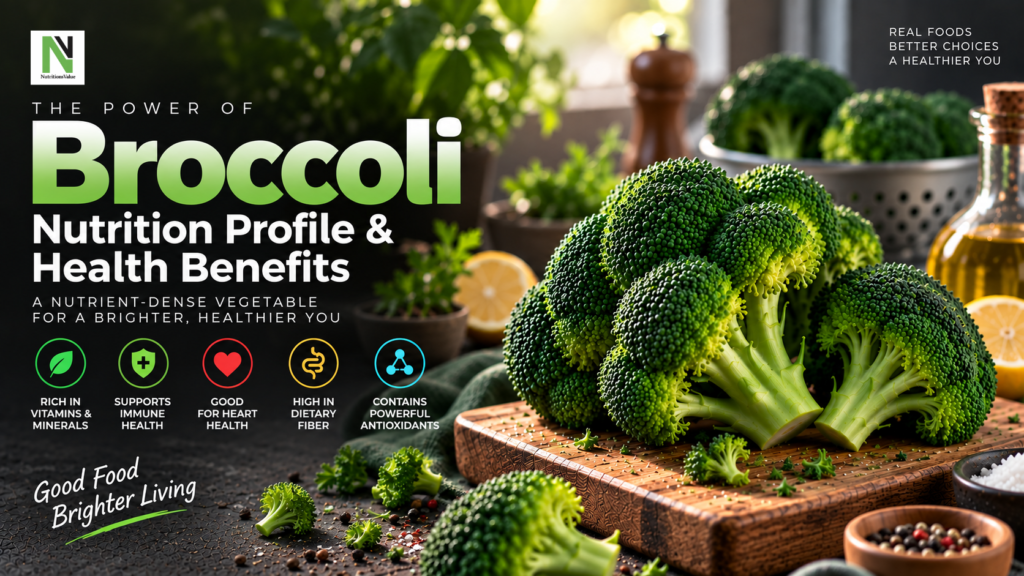
Broccoli is one of the most nutrient dense vegetables in the cruciferous family. Its green florets and edible stalk contain vitamins, minerals, fiber, and naturally occurring plant compounds that make it a valuable part of a balanced diet.
Broccoli belongs to the Brassica genus, the same broad plant group that includes cauliflower, cabbage, kale, Brussels sprouts, and several other vegetables. One of the reasons broccoli receives so much attention in nutrition research is its content of glucosinolates, sulfur containing compounds that can be converted during food preparation and digestion into compounds such as isothiocyanates and indoles. Sulforaphane, an isothiocyanate associated with broccoli and other cruciferous vegetables, has been extensively studied in laboratory and human research.
However, broccoli should not be viewed as a miracle food or a treatment for disease. Its greatest value comes from its overall nutritional profile and its place within a varied diet rich in vegetables, fruits, whole grains, protein foods, and other nutrient-dense foods.
In this comprehensive guide, we will explore broccoli’s nutritional value, vitamins and minerals, fiber, glucosinolates, potential health benefits, cooking methods, raw versus cooked broccoli, ways to include it in your diet, and important safety considerations.
Quick Answer: Broccoli is a low-calorie, nutrient-dense cruciferous vegetable that provides vitamin C, vitamin K, folate, fiber, potassium, and several other nutrients. Raw broccoli provides approximately 34 calories, 2.82 grams of protein, 6.64 grams of carbohydrate, and 2.6 grams of dietary fiber per 100 grams. It is also particularly rich in vitamin C and provides substantial vitamin K.
Broccoli also contains glucosinolates, which can form biologically active compounds such as isothiocyanates during chewing, preparation, and digestion. Research into cruciferous vegetables has identified potentially beneficial associations with several health outcomes, but evidence in humans is not strong enough to describe broccoli as a treatment or guaranteed disease prevention food.
What Is Broccoli?
Broccoli is a vegetable belonging to the Brassicaceae or cruciferous vegetable family.
Its scientific name is commonly given as Brassica oleracea var. italica.
The part most commonly eaten is the immature flowering head, consisting of many small green florets attached to a thick stalk. However, the stalk and leaves can also be edible when prepared appropriately.
Broccoli is commonly eaten:
- Steamed
- Roasted
- Stir-fried
- Boiled
- Blanched
- Grilled
- Added to soups
- Added to salads
- Used in curries
- Combined with pasta or grains
- Added to omelets and other dishes
Its mild flavor makes it relatively easy to combine with many different foods.
Broccoli Nutrition Profile
One of the biggest strengths of broccoli is its high nutrient density relative to its calorie content.
According to USDA derived nutrient data, 100 grams of raw broccoli provides approximately:
| Nutrient | Amount per 100 g |
|---|---|
| Calories | 34 kcal |
| Water | 89.3 g |
| Protein | 2.82 g |
| Total Fat | 0.37 g |
| Carbohydrates | 6.64 g |
| Dietary Fiber | 2.6 g |
| Total Sugars | 1.7 g |
| Calcium | 47 mg |
| Iron | 0.73 mg |
| Magnesium | 21 mg |
| Phosphorus | 66 mg |
| Potassium | 316 mg |
| Sodium | 33 mg |
| Vitamin C | 89.2 mg |
| Folate | 63 mcg |
| Vitamin A | 31 mcg |
| Vitamin K | ~102 mcg |
The exact nutritional value can vary depending on variety, freshness, growing conditions, storage, and cooking method.
- Broccoli Is Low in Calories
Raw broccoli contains approximately 34 calories per 100 grams.
This makes it useful in meals where you want to increase vegetable volume without adding a large amount of energy.
However, the final calorie content of a broccoli dish depends heavily on what is added to it.
For example:
Steamed broccoli
and
Broccoli cooked with large amounts of butter, cheese, cream, or oil
can have very different nutritional profiles.
Therefore, when evaluating broccoli as a food, it is important to consider both the vegetable itself and the way it is prepared.
- Broccoli Provides Plant-Based Protein
Broccoli contains approximately 2.82 grams of protein per 100 grams in its raw form.
This is not enough to classify broccoli as a high-protein food, but it can make a useful contribution to total dietary protein.
For example:
Broccoli + lentils
Broccoli + tofu
Broccoli + eggs
Broccoli + fish
can create meals with a substantially higher overall protein content.
This illustrates an important nutrition principle:
Individual foods do not need to provide every nutrient in large amounts. Dietary variety allows different foods to complement one another.
- Broccoli Is a Good Source of Dietary Fiber
Broccoli provides approximately 2.6 grams of dietary fiber per 100 grams.
Fiber is an important part of a healthy dietary pattern.
Adequate fiber intake can contribute to:
- Normal digestive function
- Bowel regularity
- Satiety
- Overall diet quality
The fiber in broccoli is one reason it can be useful in meals designed around vegetables and minimally processed foods.
However, people who suddenly increase their vegetable and fiber intake may experience bloating or digestive discomfort.
If your usual diet is low in fiber, increasing intake gradually may be more comfortable.
- Broccoli Is Rich in Vitamin C
One of broccoli’s most notable nutritional features is its vitamin C content.
Raw broccoli provides approximately 89.2 mg of vitamin C per 100 grams according to USDA derived data.
The NIH Office of Dietary Supplements identifies broccoli as one of the good food sources of vitamin C. Vitamin C contributes to several normal biological functions, including collagen production, antioxidant protection, and immune function.
Vitamin C is also sensitive to heat and water. Prolonged cooking can reduce vitamin C levels, while methods such as steaming or microwaving may reduce some cooking losses compared with longer cooking methods.
This is one reason short cooking methods can be useful when preparing broccoli.
- Broccoli Provides Vitamin K
Broccoli also contains a significant amount of vitamin K.
Vitamin K is involved in normal blood clotting and other physiological processes.
The NIH Office of Dietary Supplements lists broccoli among foods that provide vitamin K.
Vitamin K is particularly relevant for people taking certain anticoagulant medications such as warfarin.
People taking warfarin do not necessarily need to eliminate broccoli, but major changes in vitamin K intake should be discussed with the healthcare professional managing their anticoagulation therapy.
Consistency is generally more important than unnecessarily avoiding nutritious vegetables.
Broccoli provides folate, a B vitamin involved in important cellular processes.
Folate contributes to:
- DNA synthesis
- Cell division
- Normal cellular metabolism
Broccoli is therefore one of many vegetables that can contribute to overall folate intake.
However, no single vegetable should be expected to meet all nutritional requirements.
A varied diet remains the most practical way to obtain different vitamins and minerals.
- Potassium and Other Minerals
Broccoli provides several minerals, including:
- Potassium
- Calcium
- Magnesium
- Phosphorus
- Iron
- Zinc
According to USDA derived data, 100 grams of raw broccoli provides approximately 316 mg of potassium, along with smaller amounts of calcium, magnesium, iron, phosphorus, and zinc.
These minerals contribute to numerous physiological functions.
For example, potassium is important for normal nerve and muscle function and fluid balance.
Broccoli should therefore be viewed as part of an overall nutrient-rich diet rather than as a concentrated supplement.
Broccoli and Glucosinolates
One of the most interesting characteristics of broccoli is its content of glucosinolates.
Glucosinolates are sulfur-containing plant compounds found throughout cruciferous vegetables.
When broccoli is:
- Chewed
- Cut
- Crushed
- Prepared
- Digested
glucosinolates can be converted into biologically active compounds, including:
- Isothiocyanates
- Indoles
- Thiocyanates
- Other breakdown products
One of the best-known compounds associated with broccoli research is sulforaphane, an isothiocyanate.
Scientists have studied these compounds because of their potential effects on cellular defense mechanisms and other biological pathways.
What Is Sulforaphane?
Sulforaphane is an isothiocyanate that can be formed from glucoraphanin, a glucosinolate found in broccoli and other cruciferous vegetables.
It has attracted considerable scientific interest because laboratory and experimental research suggests that it can influence pathways associated with:
- Oxidative stress
- Inflammation
- Cellular defense
- Detoxification enzymes
- Cell signaling
However, it is important to distinguish laboratory findings from demonstrated health outcomes in humans.
The National Cancer Institute notes that experimental studies have identified potentially anticancer effects of compounds derived from glucosinolates, but human research has produced mixed results.
Therefore:
Broccoli contains biologically active compounds that are scientifically interesting, but broccoli should not be marketed as a cancer treatment or guaranteed cancer-prevention food.
Potential Health Benefits of Broccoli
- Supports Overall Nutrient Intake
Perhaps the most reliable benefit of broccoli is simple:
It is a nutrient dense vegetable.
A serving can contribute:
- Vitamin C
- Vitamin K
- Folate
- Fiber
- Potassium
- Plant compounds
- Smaller amounts of several other nutrients
Replacing some highly processed foods with vegetables such as broccoli can improve overall dietary quality.
- May Support Digestive Health
Broccoli provides dietary fiber, which contributes to a healthy digestive system.
A diet containing adequate fiber from vegetables, fruits, legumes, and whole grains can help support regular bowel function.
However, broccoli is not a treatment for digestive disorders.
Some people may actually experience increased gas or bloating after eating large quantities of cruciferous vegetables.
This is not necessarily a sign that broccoli is harmful. It may simply reflect individual tolerance and the fermentation of certain carbohydrates and fibers in the digestive tract.
- May Support Cardiovascular Health
Broccoli can contribute to a heart-conscious dietary pattern because it provides:
- Fiber
- Potassium
- Folate
- Vitamin C
- Plant compounds
Research examining cruciferous vegetable intake has found associations between higher intake and several favorable health outcomes.
An umbrella review of 41 systematic reviews and meta-analyses involving observational studies found suggestive evidence of beneficial associations for several outcomes, including gastric cancer, lung cancer, endometrial cancer, and all-cause mortality, but also emphasized uncertainty in much of the evidence.
Research on vegetables more broadly also suggests associations between vegetable consumption and lower cardiovascular risk, although observational evidence cannot prove that one particular vegetable causes the reduction.
A recent 2026 systematic review of green leafy vegetables similarly found an association between higher intake and lower cardiovascular disease risk in observational studies, while randomized trials did not show significant improvements in vascular function.
This distinction matters:
Broccoli can be part of a heart-healthy dietary pattern, but eating broccoli alone cannot guarantee cardiovascular protection.
- Potential Role in Cancer Prevention Research
Broccoli and other cruciferous vegetables have received substantial attention in cancer research.
The reason is partly their glucosinolate content and the biologically active compounds produced from these substances.
Laboratory studies have identified mechanisms through which certain compounds may:
- Protect cells from DNA damage
- Influence carcinogen metabolism
- Affect inflammatory pathways
- Influence cell death
- Affect other processes involved in cancer biology
However, human evidence is considerably more complicated.
The National Cancer Institute reports that human studies examining cruciferous vegetables and cancer risk have produced mixed findings, with little or no association found for some cancers in several cohort studies.
Therefore, the responsible conclusion is:
Broccoli contains compounds of scientific interest in cancer research, but there is not enough evidence to claim that eating broccoli prevents or treats cancer by itself.
A diet rich in a variety of vegetables is a more appropriate recommendation.
- May Contribute to Immune-Supportive Nutrition
Vitamin C is one of broccoli’s major nutrients.
Vitamin C contributes to normal immune system function and also acts as an antioxidant.
The NIH lists broccoli among important dietary sources of vitamin C.
However, eating extra broccoli does not mean that someone can “boost” immunity beyond normal physiological needs.
The more useful message is:
Broccoli can help contribute to adequate vitamin C intake as part of a varied diet.
- Supports a Nutrient Dense Diet
Broccoli can be particularly useful for people trying to improve the nutritional quality of their meals without adding large amounts of calories.
For example:
Simple meal
Broccoli + dal + brown rice
provides a combination of:
- Vegetables
- Protein
- Fiber
- Carbohydrates
- Multiple micronutrients
This is more meaningful nutritionally than focusing on broccoli as a standalone “superfood.”
- May Be Useful in Weight Management
Broccoli is low in calories and provides fiber and water.
This combination can make vegetables useful in meals designed to support satiety while keeping overall calorie density moderate.
For example:
Broccoli + grilled tofu + whole grains
can create a more filling meal than a highly refined, low-fiber meal of similar size.
But broccoli does not directly “burn fat.”
Weight management depends on:
- Total energy intake
- Food quality
- Physical activity
- Sleep
- Long-term consistency
- Individual metabolic factors
Therefore, broccoli should be viewed as a supportive food rather than a weight-loss treatment.
Raw Broccoli vs. Cooked Broccoli
Another common question is:
Is raw broccoli healthier than cooked broccoli?
There is no universal winner.
Both raw and cooked broccoli can be nutritious.
However, cooking changes the nutrient composition and physical structure of the vegetable.
Raw Broccoli
Raw broccoli can be eaten in:
- Salads
- Vegetable bowls
- Slaws
- Sandwiches
- Dips
Because it is not exposed to heat, there are no cooking-related losses of heat-sensitive nutrients.
However, raw broccoli can be harder to digest for some people and may cause more bloating or gas.
Steamed Broccoli
Steaming is one of the simplest preparation methods.
It softens the broccoli while limiting direct contact with large amounts of water.
The NIH notes that steaming or microwaving may reduce vitamin C cooking losses compared with some other methods.
Steaming can therefore be a practical compromise between:
Raw texture + cooked digestibility
Boiled Broccoli
Boiling can cause some water-soluble nutrients to move into the cooking water.
This does not make boiled broccoli unhealthy.
However, very prolonged boiling may reduce some heat- and water-sensitive nutrients.
If boiling is your preferred method, shorter cooking times can help maintain texture and some nutrient content.
Roasted Broccoli
Roasting gives broccoli a deeper flavor and crisp texture.
It can be a very appealing way to increase vegetable intake.
However, the amount of oil, cheese, sauces, or other ingredients used during roasting affects the final calorie and nutrient profile.
Stir-Fried Broccoli
Stir-frying is another practical option.
Broccoli can be combined with:
- Tofu
- Paneer
- Chicken
- Eggs
- Mushrooms
- Bell peppers
- Carrots
This creates a nutrient-dense meal rather than simply treating broccoli as a side dish.
How to Eat More Broccoli
- Broccoli Salad
Combine broccoli with:
- Carrots
- Tomatoes
- Bell peppers
- Seeds
- A simple dressing
This can create a colorful, fiber-containing meal.
- Broccoli Stir-Fry
Combine broccoli with:
Tofu + mushrooms + bell peppers + spices
for a plant-based meal.
- Broccoli With Dal
Broccoli can be incorporated into Indian-style meals alongside dal, roti, rice, or other whole grains.
This makes it easier to integrate broccoli into familiar eating patterns.
- Broccoli Soup
Broccoli soup can be nutritious, particularly when prepared with vegetables and moderate amounts of added fat.
Be cautious about recipes that rely heavily on:
- Cream
- Butter
- Cheese
- Salt
because these can substantially change the nutritional profile.
- Roasted Broccoli
Toss broccoli with a modest amount of oil and seasonings and roast until tender.
This is a simple way to make broccoli more appealing for people who do not enjoy boiled vegetables.
- Broccoli With Protein
A particularly useful strategy is:
Vegetable + protein + whole-food carbohydrate
For example:
Broccoli + tofu + brown rice
or
Broccoli + chicken + whole-grain roti
or
Broccoli + dal + millet
This turns broccoli from a simple side dish into part of a complete meal.
How to Select Fresh Broccoli
When buying broccoli, look for:
- Firm stalks
- Compact florets
- Fresh green color
- Minimal yellowing
- No strong unpleasant odor
- No excessive sliminess
- No obvious mold
Some varieties naturally have slightly different shades of green or purple, so color alone should not determine freshness.
How to Store Broccoli
Fresh broccoli should be stored appropriately in the refrigerator.
Avoid keeping it exposed to unnecessary moisture for long periods.
Before storage:
- Remove damaged parts.
- Keep it refrigerated.
- Use within an appropriate period.
- Follow packaging instructions for pre-cut or packaged broccoli.
Proper storage helps maintain quality and reduces food waste.
Broccoli and Food Safety
Like other fresh vegetables, broccoli should be handled hygienically.
Before eating raw broccoli:
- Wash your hands.
- Use clean utensils and surfaces.
- Rinse the vegetable appropriately under clean running water.
- Remove visibly damaged areas.
- Refrigerate leftovers promptly.
Washing vegetables can reduce some surface contamination but does not guarantee elimination of all pathogens.
People who are particularly vulnerable to foodborne illness may prefer properly cooked vegetables.
Can People With Diabetes Eat Broccoli?
Broccoli can generally fit well into a diabetes conscious eating pattern.
It contains relatively little carbohydrate compared with many staple carbohydrate foods and provides fiber.
It can be paired with:
- Lentils
- Eggs
- Tofu
- Fish
- Chicken
- Whole grains
However, broccoli should not be described as a treatment for diabetes.
For diabetes management, the overall meal, carbohydrate intake, medication, physical activity, and individual blood-glucose response are more important than any single vegetable.
Is Broccoli Good for Weight Loss?
Broccoli can be useful in a weight management diet because it is relatively low in calories and contains fiber.
However:
Broccoli does not directly cause fat loss.
A sustainable weight-management strategy should focus on:
- Appropriate calorie intake
- Adequate protein
- High quality carbohydrates
- Vegetables
- Fiber
- Physical activity
- Sleep
- Long-term consistency
Broccoli can support that strategy, but it cannot replace it.
Broccoli and Thyroid Health
Cruciferous vegetables sometimes receive negative attention because they contain compounds known as goitrogens.
This has led to concerns that eating broccoli could interfere with thyroid function.
For most people eating normal amounts of cruciferous vegetables as part of a balanced diet, this is not a reason to avoid broccoli.
However, people with diagnosed thyroid conditions who have concerns about very high intakes of cruciferous vegetables particularly in unusual forms such as concentrated raw preparations should discuss their diet with a healthcare professional.
The broader evidence on cruciferous vegetables does not justify recommending that healthy people avoid broccoli.
Broccoli and Blood Thinning Medication
Broccoli contains vitamin K.
People taking warfarin or another vitamin K sensitive anticoagulant should not make sudden major changes to their intake without medical advice.
The goal is generally not to eliminate nutritious vegetables but to maintain a consistent dietary pattern that can be appropriately accounted for in medication management.
If you take anticoagulants, discuss significant dietary changes with your healthcare professional.
Can You Eat Broccoli Every Day?
For many healthy people, eating broccoli regularly can be part of a healthy diet.
However, there is no requirement to eat broccoli every single day.
Dietary variety is important.
Rotate broccoli with other vegetables such as:
- Cauliflower
- Cabbage
- Carrots
- Spinach
- Green beans
- Peas
- Bell peppers
- Tomatoes
- Moringa leaves
- Other seasonal vegetables
This gives you access to a broader range of nutrients and plant compounds.
Possible Side Effects of Broccoli
Broccoli is generally well tolerated as a food, but some people may experience:
Gas
Cruciferous vegetables contain fermentable carbohydrates and fiber that can contribute to gas.
Bloating
Large portions may cause bloating, particularly in people with sensitive digestion.
Digestive discomfort
People with certain digestive conditions may find large amounts uncomfortable.
The solution is not necessarily to eliminate broccoli completely.
Try:
- Smaller portions
- Well-cooked broccoli
- Gradual increases
- Different preparation methods
If symptoms are persistent or severe, discuss them with a healthcare professional.
Broccoli: Myths vs. Facts
Myth | Fact |
Broccoli cures cancer | Human evidence does not support broccoli as a cancer treatment |
Broccoli burns fat | It can be useful in a calorie-conscious diet but does not directly burn fat |
Raw broccoli is always healthier | Both raw and cooked broccoli can be nutritious |
Broccoli has no protein | It provides some protein, although it is not a high-protein food |
Broccoli should never be cooked | Cooking is perfectly acceptable; preparation affects different nutrients differently |
Everyone with thyroid problems must avoid broccoli | Normal dietary amounts are generally not a reason for universal avoidance |
More broccoli is always better | Excessive amounts may cause digestive discomfort |
Broccoli alone provides complete nutrition | A healthy diet requires a variety of foods |
Broccoli vs. Cauliflower
Broccoli and cauliflower are closely related cruciferous vegetables.
Broccoli
Known for:
- Vitamin C
- Vitamin K
- Folate
- Fiber
- Green pigments and carotenoids
- Glucosinolates
Cauliflower
Known for:
- Vitamin C
- Fiber
- Folate
- Lower-energy-density meal applications
- Versatility as a rice or mash substitute
Neither needs to be declared the universally “healthier” vegetable.
A varied diet can include both.
Broccoli vs. Spinach
Both vegetables are nutrient-dense, but their nutrient profiles differ.
Broccoli
Particularly notable for:
- Vitamin C
- Vitamin K
- Fiber
- Glucosinolates
Spinach
Particularly notable for:
- Vitamin K
- Folate
- Carotenoids
- Magnesium
- Iron
Instead of asking:
“Which vegetable is healthiest?”
a more useful question is:
“Which nutrients and foods can I include throughout the week?”
The answer is often: both.
How Much Broccoli Should You Eat?
There is no universal broccoli serving that is perfect for everyone.
Your vegetable intake should fit within your overall dietary needs.
For many people, a practical portion might be around:
½ to 1 cup of cooked broccoli
or an equivalent amount of raw broccoli.
However, individual needs vary.
The broader goal should be to consume a variety of vegetables regularly rather than focusing on a single target amount of broccoli.
Who May Need Individualized Advice?
Most healthy people can enjoy broccoli as part of a balanced diet.
However, individualized advice may be appropriate for people with:
- Significant digestive disorders
- Food allergies
- Certain kidney conditions
- Specific thyroid conditions
- Anticoagulant medication use
- Individual dietary restrictions
If you have a medical condition or take prescription medication, major dietary changes should be discussed with your healthcare professional.
FAQs
Is broccoli a superfood?
“Superfood” is a marketing term rather than a formal scientific category. Broccoli is certainly nutrient-dense and provides several valuable nutrients and plant compounds, but overall dietary variety is more important than relying on a single food.
How much protein does broccoli contain?
Raw broccoli provides approximately 2.82 grams of protein per 100 grams.
It contributes to total protein intake but should not be considered a high-protein food.
Is broccoli high in vitamin C?
Yes. Raw broccoli provides approximately 89.2 mg of vitamin C per 100 grams, although the amount can vary and cooking can reduce vitamin C content.
Is broccoli good for weight loss?
Broccoli can be useful in a calorie-conscious, nutrient-dense diet, but it does not independently cause weight loss.
Is broccoli good for diabetes?
Broccoli can fit into many diabetes-friendly eating patterns. However, it is not a treatment for diabetes.
Is raw broccoli better than cooked broccoli?
Not necessarily. Raw broccoli avoids cooking losses of some heat-sensitive nutrients, while cooking can improve texture and may make broccoli easier for some people to digest. Steaming is one practical preparation method.
Does broccoli prevent cancer?
Research into cruciferous vegetables and cancer is extensive, but human results are mixed. Broccoli should not be considered a cancer treatment or guaranteed cancer-prevention food.
Does broccoli contain sulforaphane?
Broccoli contains glucoraphanin, a glucosinolate that can contribute to the formation of sulforaphane. The amount formed can depend on the vegetable, preparation, and other factors.
Can people taking warfarin eat broccoli?
Broccoli contains vitamin K. People taking warfarin should avoid sudden major changes in vitamin-K intake and discuss dietary changes with their healthcare professional.
Can broccoli cause gas?
Yes. Cruciferous vegetables can cause gas or bloating in some people, particularly when eaten in large quantities.
Can you eat broccoli every day?
Many healthy people can eat broccoli regularly, but eating a variety of vegetables is generally preferable to relying on one vegetable every day.
NutritionsValue Bottom Line
Broccoli is one of the most useful vegetables to include in a varied, nutrient rich diet.
Its nutritional profile is impressive for a relatively low-calorie food. It provides:
- Vitamin C
- Vitamin K
- Folate
- Dietary fiber
- Potassium
- Calcium
- Magnesium
- Plant-based protein
- Glucosinolates and other plant compounds
Its glucosinolate content makes broccoli particularly interesting from a research perspective. Compounds derived from these substances, including isothiocyanates such as sulforaphane, have been studied for their biological effects. However, human evidence is not strong enough to describe broccoli as a cure or guaranteed prevention strategy for cancer or other diseases.
The most practical way to benefit from broccoli is therefore not to treat it as a miracle food.
Instead:
Eat broccoli regularly, prepare it in ways you enjoy, combine it with protein and other nutrient-rich foods, and maintain variety across your entire diet.
For most people, steamed, roasted, stir-fried, or lightly cooked broccoli can be an excellent addition to everyday meals.
And perhaps the most important lesson is this:
The health value of broccoli comes not from one isolated nutrient or compound, but from the combination of nutrients, fiber, plant compounds, low energy density, and its role in an overall healthy dietary pattern.
Explore More Related Articles
🥦 Compare Spinach vs Broccoli
🍎 A Comparative Analysis of the Most Nutritious Fruits in the World
📊 Check Spinach Nutrition
🥗 Explore Healthy Vegetables
🥦Spinach: Nutrition, Benefits, Uses & Safety
⚖️ Compare Spinach vs Broccoli
📧 Get NutritionsValue Weekly
Medical & Nutrition Disclaimer
This article is intended for educational and informational purposes only. It does not provide medical diagnosis, treatment, or individualized dietary advice.
People with medical conditions, food allergies, significant digestive problems, kidney conditions, thyroid disorders, or those taking prescription medications should consult an appropriately qualified healthcare professional before making major dietary changes.
Do not stop, replace, or modify prescribed medication based solely on information about broccoli or any other food.
References
- U.S. Department of Agriculture FoodData Central / USDA nutrient data — Broccoli, raw.
- NIH Office of Dietary Supplements — Vitamin C Fact Sheet for Health Professionals.
- NIH Office of Dietary Supplements — Vitamin K Fact Sheet for Consumers.
- National Cancer Institute — Cruciferous Vegetables and Cancer Prevention.
- Li et al. — Umbrella review of cruciferous vegetable consumption and multiple health outcomes. Food & Function, 2022.
- Cruciferous vegetable and isothiocyanate intake and multiple health outcomes — umbrella review of systematic reviews and meta-analyses.
Dietary Green Leafy Vegetables and Cardiovascular Disease Risk systematic review and meta-analysis, 2026.