
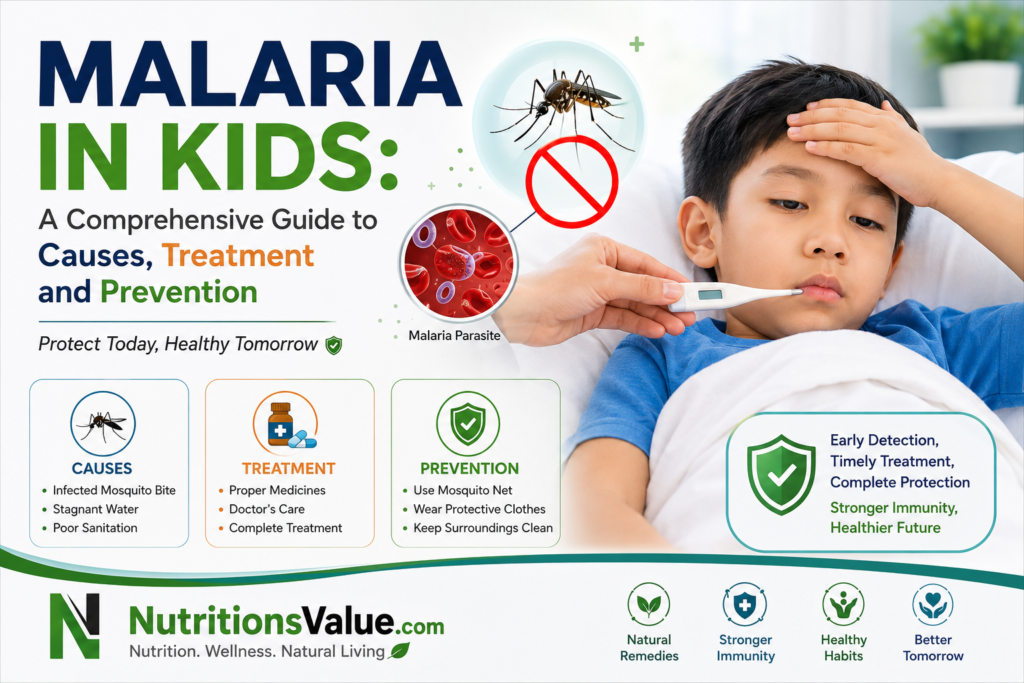
Malaria is one of the most important mosquito-borne diseases affecting children in tropical and subtropical regions. Although malaria is preventable and curable, it can become dangerous quickly in young children if diagnosis and treatment are delayed. Fever in a child should therefore never be ignored when malaria is circulating in the local area.
According to the World Health Organization (WHO), malaria caused an estimated 282 million cases and 610,000 deaths globally in 2024. Children under 5 years of age remain particularly vulnerable to severe malaria, especially in high-transmission regions.
The good news is that parents can significantly reduce a child’s risk by preventing mosquito bites, recognizing warning signs early, seeking testing promptly, and following the prescribed treatment completely.
This comprehensive guide explains malaria in kids, its causes, symptoms, diagnosis, treatment, severe complications, home care, nutrition, prevention, mosquito protection and malaria vaccines in simple language.
What Is Malaria in Kids?
Malaria is an infectious disease caused by parasites belonging to the Plasmodium group. It is primarily transmitted through the bite of an infected female Anopheles mosquito.
When an infected mosquito bites a child, malaria parasites enter the bloodstream. They travel to the liver, multiply, and subsequently infect red blood cells. As the infection progresses, the child may develop fever and other symptoms.
Malaria is not normally spread by ordinary person-to-person contact. It is mainly transmitted through infected mosquitoes, although transmission can also occur through infected blood or contaminated needles in certain circumstances.
Several Plasmodium species can cause malaria in humans. The two most important are:
- Plasmodium falciparum
- Plasmodium vivax
- falciparum is particularly dangerous because untreated infection can progress rapidly to severe malaria. P. vivax can also cause significant illness and may relapse because dormant parasite stages can remain in the liver.
Why Is Malaria More Dangerous for Young Children?
Young children have a higher risk of developing severe malaria because they may have less immunity against malaria parasites, particularly in areas where malaria transmission is common.
WHO identifies infants and children under 5 as groups at increased risk of severe disease. Severe malaria in children may involve complications such as severe anemia, breathing difficulties and cerebral malaria.
A child with malaria may initially appear to have an ordinary viral fever. This makes early testing especially important.
Parents should remember:
Fever + possible mosquito exposure + residence or travel in a malaria-risk area = malaria should be considered and medically evaluated.
Causes of Malaria in Children
- Infected Anopheles Mosquito Bite
The most common cause is the bite of an infected female Anopheles mosquito.
The mosquito becomes infected after biting a person carrying malaria parasites. It can then transmit the parasites when it bites another person.
- Living in or Visiting a Malaria-Risk Area
Children living in areas where malaria transmission occurs have a greater chance of exposure.
Risk can increase during periods when mosquito populations rise, although transmission patterns vary considerably by location.
- Inadequate Mosquito Protection
Children who sleep without effective mosquito protection may have greater exposure to infected mosquitoes.
Risk can increase when homes have:
- Open windows without screens
- Standing water nearby
- Poor mosquito control
- Inadequate bed-net use
- Outdoor sleeping arrangements
- High mosquito activity
- Rare Blood-Related Transmission
Malaria can occasionally be transmitted through infected blood, contaminated needles or certain medical procedures. This is much less common than mosquito transmission.
Malaria Symptoms in Kids
The symptoms of malaria can vary depending on the parasite species, the child’s age, immunity and severity of infection.
Common symptoms include:
- Fever
- Chills
- Headache
- Weakness
- Tiredness
- Body aches
- Sweating
- Poor appetite
- Nausea
- Vomiting
- Abdominal discomfort
WHO notes that fever, headache and chills are common early symptoms. Symptoms may initially be mild and can resemble many other childhood illnesses.
Malaria Symptoms in Babies
Babies may not be able to tell parents what they are experiencing. Instead, parents may notice:
- Fever or abnormal temperature
- Irritability
- Excessive sleepiness
- Poor feeding
- Vomiting
- Weakness
- Rapid breathing
- Reduced activity
- Unusual crying
Because babies can deteriorate quickly, medical evaluation should not be delayed when malaria is suspected.
Early Signs Parents Should Watch For
Malaria may not always follow the classic pattern of fever, chills and sweating.
A child may simply have:
Fever + unusual tiredness + poor appetite + headache or vomiting.
In malaria-endemic regions, parents should not assume that every fever is a common viral infection.
If the fever persists, returns repeatedly, or the child appears unusually weak, medical assessment is important.
Severe Malaria in Children: Warning Signs
Severe malaria is a medical emergency.
Seek urgent medical care immediately if a child with suspected or confirmed malaria develops any of the following:
- Difficulty breathing
- Very fast breathing
- Severe weakness
- Extreme sleepiness or difficulty waking
- Confusion
- Loss of consciousness
- Seizures or convulsions
- Repeated vomiting
- Inability to drink or breastfeed
- Severe anemia or marked pallor
- Yellowing of the eyes or skin
- Dark or bloody urine
- Abnormal bleeding
- Collapse
WHO lists impaired consciousness, multiple convulsions, difficulty breathing, dark or bloody urine, jaundice and abnormal bleeding among severe malaria warning signs.
Do not wait for the fever to become extremely high before seeking help.
Untreated P. falciparum malaria can progress to severe illness rapidly.
How Is Malaria Diagnosed in Children?
Symptoms alone cannot reliably confirm malaria because many childhood infections can cause fever.
WHO recommends confirming suspected malaria using parasite-based testing, generally through:
A blood sample is examined under a microscope to identify malaria parasites.
Microscopy can provide information about the parasite and may help determine the species and parasite density.
- Rapid Diagnostic Test (RDT)
A malaria rapid diagnostic test detects parasite-related proteins in a small blood sample.
RDTs can be particularly useful where microscopy is not immediately available.
WHO recommends prompt malaria diagnosis using microscopy or an appropriate rapid diagnostic test in people with suspected malaria.
Why Testing Matters
Fever in children can be caused by:
- Viral infections
- Dengue
- Typhoid
- Respiratory infections
- Urinary infections
- Other bacterial infections
- Other mosquito-borne diseases
Therefore, giving an antimalarial medicine without appropriate medical evaluation can be inappropriate and potentially harmful.
Malaria Treatment in Kids
Malaria requires treatment with antimalarial medicine. The exact treatment depends on several factors, including:
- Malaria parasite species
- Local drug resistance patterns
- Severity of disease
- Child’s age
- Child’s body weight
- Previous treatment
- Pregnancy is not relevant to children, but special considerations apply to infants and other vulnerable groups
- Local/national treatment guidelines
WHO’s current malaria guidelines were updated in August 2025 and are periodically revised as new evidence becomes available.
Treatment for Uncomplicated Malaria
For uncomplicated P. falciparum malaria, artemisinin-based combination therapies (ACTs) are the mainstay of recommended treatment.
Treatment for P. vivax and other malaria species can differ according to the parasite, geographic area and drug sensitivity.
For some infections, additional treatment may be required to prevent relapse. For example, P. vivax and P. ovale can have dormant liver stages, and medicines used for relapse prevention require appropriate medical assessment, including consideration of G6PD status where relevant.
Important:
Never give a child an adult malaria medicine or calculate an antimalarial dose yourself.
Children require weight-appropriate treatment, and some malaria medicines have important safety considerations.
Treatment of Severe Malaria
Severe malaria requires urgent hospital-based treatment.
WHO recommends injectable antimalarial treatment such as parenteral artesunate for severe malaria, followed by appropriate oral therapy once the child can safely take oral medication.
Hospital care may also be needed for complications such as:
- Severe anemia
- Low blood sugar
- Seizures
- Breathing difficulties
- Altered consciousness
- Dehydration
- Kidney or other organ complications
Parents should not attempt to manage severe malaria at home.
Why Completing Malaria Treatment Is So Important
One of the most important things parents can do is ensure that the child completes the prescribed course.
Stopping treatment early because the fever improves may allow parasites to survive.
Incomplete treatment can contribute to:
- Treatment failure
- Recurrent illness
- Persistent infection
- Transmission to mosquitoes
- Drug resistance
WHO emphasizes effective treatment to eliminate parasites, prevent progression to severe disease and reduce transmission.
If a child vomits medicine, misses a dose or develops new symptoms, parents should contact the treating healthcare professional rather than automatically repeating or changing the dose.
Can Herbal Remedies Treat Malaria in Children?
Malaria is a serious mosquito-borne infection that can become dangerous very quickly in children. Parents naturally look for gentle, natural and easily available remedies when a child develops fever. This often raises an important question:
Can herbal remedies treat malaria in children?
The short answer is no-not as a replacement for proven antimalarial treatment.
Some plants have played an important role in the history of malaria treatment. In fact, artemisinin, a major component of modern antimalarial medicines, was originally derived from Artemisia annua, also known as sweet wormwood. However, there is a major difference between a standardized pharmaceutical medicine containing a controlled dose of an active ingredient and drinking an herbal tea or taking an unregulated herbal preparation.
The World Health Organization (WHO) specifically does not support the use of non-pharmaceutical Artemisia plant material—such as teas, tablets or capsules—for preventing or treating malaria.
For children, this distinction is especially important because malaria can progress rapidly, particularly in young children.
Why Do Parents Consider Herbal Remedies?
Herbal remedies are commonly considered because they may appear:
- Natural
- Affordable
- Easily available
- Familiar from traditional practices
- Less intimidating than medicines
- Convenient for home use
Families may traditionally use preparations containing plants such as neem, tulsi, ginger, turmeric or various bitter herbs when a child has fever.
However, relieving a symptom is not the same as eliminating the malaria parasite.
A drink may make a child feel temporarily better, improve fluid intake or provide comfort, but that does not demonstrate that it has cleared malaria parasites from the bloodstream.
This distinction can be critical.
Can Herbal Remedies Kill the Malaria Parasite?
Some plants contain compounds that have demonstrated antimalarial activity in laboratory research. But laboratory activity does not automatically mean that consuming the plant as a tea, powder or homemade preparation will safely cure malaria in a child.
There are several problems:
- Uncertain Dose
The amount of an active compound can vary between plants, leaves, extracts and preparations.
- Variable Quality
Herbal products may differ in:
- Plant species
- Growing conditions
- Harvesting
- Processing
- Storage
- Contamination
- Concentration of active compounds
- Lack of Reliable Standardization
A homemade herbal preparation does not necessarily provide a predictable therapeutic dose.
- Risk of Incomplete Treatment
If an herbal preparation reduces fever without eliminating the parasites, parents may incorrectly believe the child has recovered.
- Possible Drug Interactions
Some herbal products can interact with prescription medicines.
For a potentially life-threatening infection such as malaria, these uncertainties are unacceptable as a substitute for effective treatment.
WHO highlights standardization, dosage, quality assurance, safety and evidence of efficacy as important limitations of traditional herbal preparations used for malaria.
What About Artemisia and Artemisinin?
This is where considerable confusion exists.
Artemisia annua is a plant from which artemisinin was discovered. Modern antimalarial medicines use purified artemisinin derivatives in carefully formulated combinations.
WHO recommends artemisinin-based combination therapies (ACTs) for appropriate malaria infections, particularly P. falciparum malaria.
But this does not mean that drinking Artemisia annua tea is equivalent to taking an ACT.
It is an important difference:
Artemisia plant ≠ standardized ACT medicine
Modern ACTs contain controlled amounts of pharmaceutical ingredients and combine an artemisinin derivative with another antimalarial drug. The combination is designed to rapidly reduce parasites and eliminate the remaining infection.
WHO therefore does not recommend Artemisia plant material as a treatment for malaria.
Why Is Herbal Self-Treatment Particularly Risky for Children?
Children are not simply small adults.
Their medicine doses often depend on:
- Body weight
- Age
- Development
- Severity of infection
- Parasite species
- Other medicines
- Overall health
An incorrect dose may be ineffective or potentially harmful.
More importantly, malaria can become severe while a parent is waiting to see whether an herbal remedy works.
WHO recommends prompt diagnosis and effective treatment because early treatment reduces the risk of severe disease and death.
Can Herbal Remedies Be Used Alongside Medical Treatment?
This is a more complicated question.
Parents should tell the child’s doctor about every herbal product, supplement or traditional preparation the child is receiving.
A healthcare professional can determine whether a particular product should be avoided because of:
- Possible interactions
- Unknown ingredients
- Allergic reactions
- Liver or kidney concerns
- Contamination
- Lack of reliable dosing
Most importantly, an herbal remedy should never delay diagnosis or replace prescribed antimalarial treatment.
If malaria has been confirmed, follow the treatment plan given by the healthcare professional.
Should Children Be Given Neem, Tulsi or Other Herbs for Malaria?
There is insufficient evidence to recommend common household herbs as a replacement for proven malaria treatment in children.
Neem, tulsi, ginger, turmeric and other plants may have traditional uses and may contain biologically active compounds, but this does not establish that they can cure malaria.
Parents should be particularly cautious about giving concentrated herbal extracts or mixtures to young children without professional advice.
Natural does not automatically mean safe, and traditional use does not automatically prove clinical effectiveness.
Home Care During Malaria Recovery
Medical treatment is the priority, but supportive care can help a child recover.
- Encourage Fluids
Offer age-appropriate fluids frequently.
Depending on the child’s age, this may include:
- Breast milk
- Water
- Oral rehydration solution when medically appropriate
- Soups
- Other suitable fluids recommended by the child’s healthcare provider
If the child is repeatedly vomiting or unable to drink, seek medical attention.
- Continue Breastfeeding
Breastfeeding should generally continue during illness unless a healthcare professional advises otherwise.
Breast milk provides fluids and nutrition while the child is recovering.
- Offer Small, Frequent Meals
A sick child may not want large meals.
Instead, offer small portions more frequently.
Examples include:
- Soft rice
- Khichdi
- Dal
- Vegetables
- Fruits
- Yogurt/curd if tolerated
- Eggs
- Soft homemade foods
The child’s age and dietary tolerance should guide food choices.
- Allow Adequate Rest
Fever and malaria can cause considerable fatigue.
Allow the child to sleep and rest, while continuing to monitor:
- Alertness
- Fluid intake
- Urination
- Breathing
- Fever
- Appetite
A child who becomes unusually difficult to wake requires urgent medical assessment.
Nutrition During and After Malaria
Good nutrition does not replace antimalarial treatment, but adequate nutrition supports recovery.
Parents should focus on a balanced diet containing:
Protein
Examples:
- Eggs
- Dal
- Beans
- Lentils
- Milk or yogurt
- Fish
- Chicken
- Other age-appropriate protein foods
Iron-Rich Foods
Malaria can contribute to anemia, particularly when red blood cells are destroyed.
Iron-rich foods include:
- Lentils
- Beans
- Green leafy vegetables
- Eggs
- Meat
- Fortified foods
However, do not start iron supplements solely because a child has malaria. A doctor should determine whether supplementation is necessary.
Fruits and Vegetables
Provide a variety of fruits and vegetables to support overall nutritional recovery.
Examples include:
- Bananas
- Oranges
- Guava
- Papaya
- Apples
- Carrots
- Spinach
- Pumpkin
- Other seasonal produce
Avoid Forcing Food
If appetite is low, focus first on fluids and small, nutritious meals.
As the child recovers, appetite generally improves.
How to Prevent Malaria in Children
Prevention is one of the strongest tools parents have.
WHO recommends effective malaria vector-control measures for people at risk.
- Use an Insecticide-Treated Bed Net
Children should sleep under an appropriate insecticide-treated net in malaria-risk areas.
The net should:
- Completely cover the sleeping area
- Be properly tucked or positioned
- Be maintained according to instructions
- Not have significant holes
Long-lasting insecticidal nets are an important malaria prevention tool.
- Reduce Mosquito Exposure
Parents can reduce mosquito exposure by:
- Using window and door screens
- Wearing appropriate clothing
- Using mosquito repellents suitable for the child’s age
- Keeping sleeping areas protected
- Following local mosquito-control recommendations
For young children, always check the product label and follow age-specific instructions before using a mosquito repellent.
- Reduce Mosquito Breeding Sites
Mosquitoes can breed in standing water.
Regularly check around the home for:
- Open containers
- Buckets
- Flowerpots
- Old tyres
- Water storage containers
- Other places where water can accumulate
Local mosquito-control programmes may also use measures such as larval control and indoor residual spraying where appropriate.
India’s National Center for Vector Borne Diseases Control includes insecticide-treated nets, indoor residual spraying and other vector-control measures among malaria-control strategies.
Malaria Vaccines for Children
An important recent development in malaria prevention is the availability of WHO-recommended malaria vaccines.
WHO recommends RTS,S/AS01 and R21/Matrix-M vaccines for prevention of P. falciparum malaria in children living in malaria-endemic areas, particularly areas with moderate or high transmission.
WHO recommends a four-dose schedule beginning at around 5 months of age in programmes using the recommended malaria vaccines. A fifth dose may be considered in some settings where malaria risk remains high.
However, malaria vaccines are not a replacement for mosquito protection, testing or treatment.
They are intended to be part of a comprehensive malaria-control strategy.
Parents should follow the vaccination programme available in their country or region and discuss eligibility with a healthcare professional.
Malaria vs Dengue: Why Parents Should Not Guess
Malaria and dengue can both cause fever and may occur in the same geographic regions.
Some symptoms overlap:
|
Feature |
Malaria |
Dengue |
|
Fever |
Common |
Common |
|
Headache |
Common |
Common |
|
Chills |
Can occur |
Less characteristic |
|
Vomiting |
Possible |
Possible |
|
Body aches |
Possible |
Often prominent |
|
Mosquito transmission |
Yes |
Yes |
|
Diagnostic testing |
Malaria parasite testing |
Dengue-specific testing where appropriate |
Because symptoms overlap, testing and professional assessment are important.
A parent should not assume that a child’s fever is malaria or dengue based only on symptoms.
Common Mistakes Parents Should Avoid
Mistake 1: Waiting Too Long
Do not wait several days when malaria is suspected.
Early diagnosis and treatment can reduce the risk of severe disease.
Mistake 2: Using Leftover Medicines
Never use leftover antimalarial tablets from an earlier illness.
The current infection may involve a different parasite species or require a different treatment.
Mistake 3: Giving Adult Doses to Children
Children require age- and weight-appropriate treatment.
Mistake 4: Stopping Medicine When Fever Improves
Always follow the prescribed treatment course.
Mistake 5: Depending Only on Home Remedies
Home remedies cannot replace appropriate malaria treatment.
Mistake 6: Ignoring Mosquito Protection After Recovery
A child who has recovered can become infected again.
Prevention must continue.
When Should Parents Take a Child to the Doctor?
Seek medical advice when:
- The child has fever and lives in or has travelled to a malaria-risk area.
- Malaria exposure is suspected.
- Fever persists or returns.
- The child becomes unusually weak.
- The child has repeated vomiting.
- The child is not drinking adequately.
- The child develops breathing difficulties.
- The child becomes unusually sleepy or confused.
- A child with confirmed malaria is not improving as expected.
Go to emergency care immediately if:
- The child has seizures.
- The child loses consciousness.
- The child has severe difficulty breathing.
- The child cannot drink or breastfeed.
- The child is extremely weak or difficult to wake.
- There is severe bleeding.
- The child develops other signs of severe malaria.
A Simple Malaria Safety Checklist for Parents
If your child has fever:
Step 1: Consider where you live and whether malaria is circulating locally.
Step 2: Consider recent travel or mosquito exposure.
Step 3: Contact a healthcare professional if malaria is possible.
Step 4: Get appropriate diagnostic testing.
Step 5: If malaria is confirmed, give the prescribed treatment exactly as directed.
Step 6: Continue fluids and appropriate nutrition.
Step 7: Watch closely for danger signs.
Step 8: Continue mosquito protection even after recovery.
FAQ About Malaria in Kids
Can malaria be cured in children?
Yes. Malaria is a treatable and curable disease when the correct diagnosis and appropriate treatment are provided promptly.
Is malaria contagious?
Malaria does not normally spread through ordinary contact such as touching, hugging or sharing food. It is mainly transmitted through infected Anopheles mosquitoes.
Can malaria occur without obvious chills?
Yes. Malaria symptoms vary. Some children may have fever and nonspecific symptoms without the classic pattern of chills and sweating.
Can a child get malaria more than once?
Yes. Previous malaria infection does not necessarily provide complete protection against future infections. Some species can also cause relapse.
Is every fever in a child malaria?
No. Many childhood illnesses cause fever. Appropriate testing is needed when malaria is suspected.
Can malaria cause anemia?
Yes. Malaria can contribute to anemia because parasites infect and destroy red blood cells. Severe anemia is an important complication of severe malaria in children.
Can malaria cause seizures?
Seizures can occur in severe malaria, particularly with cerebral malaria. A child having seizures requires emergency medical care.
Can malaria be prevented?
Yes. Prevention includes mosquito-bite protection, vector-control measures, and in eligible malaria-endemic settings, malaria vaccines and other preventive interventions.
Should parents give antibiotics for malaria?
No. Malaria is caused by Plasmodium parasites and requires appropriate antimalarial treatment. Antibiotics should only be used when prescribed for a diagnosed bacterial infection or another appropriate medical indication.
Conclusion: Protecting Children From Malaria
Malaria in children should always be taken seriously, but parents should also know that it is preventable and treatable.
The most important protection strategy combines:
Mosquito protection + early testing + prompt treatment + complete treatment + good supportive nutrition + ongoing prevention.
Parents should learn the warning signs of severe malaria and seek emergency care when a child develops breathing difficulty, seizures, altered consciousness, extreme weakness, inability to drink, severe pallor, jaundice, dark or bloody urine or other serious symptoms.
WHO’s malaria guidance is regularly updated as evidence changes, so treatment recommendations can vary according to parasite species, local drug resistance and national policy.
For families in India, the National Center for Vector Borne Diseases Control (NCVBDC) provides national malaria-control information and maintains guidance on diagnosis, treatment, vector control and the National Strategic Plan for Malaria 2023–27.
Most importantly, do not rely on symptoms alone and do not delay medical care when malaria is suspected. Early diagnosis and effective treatment can make a major difference in protecting a child’s health.