
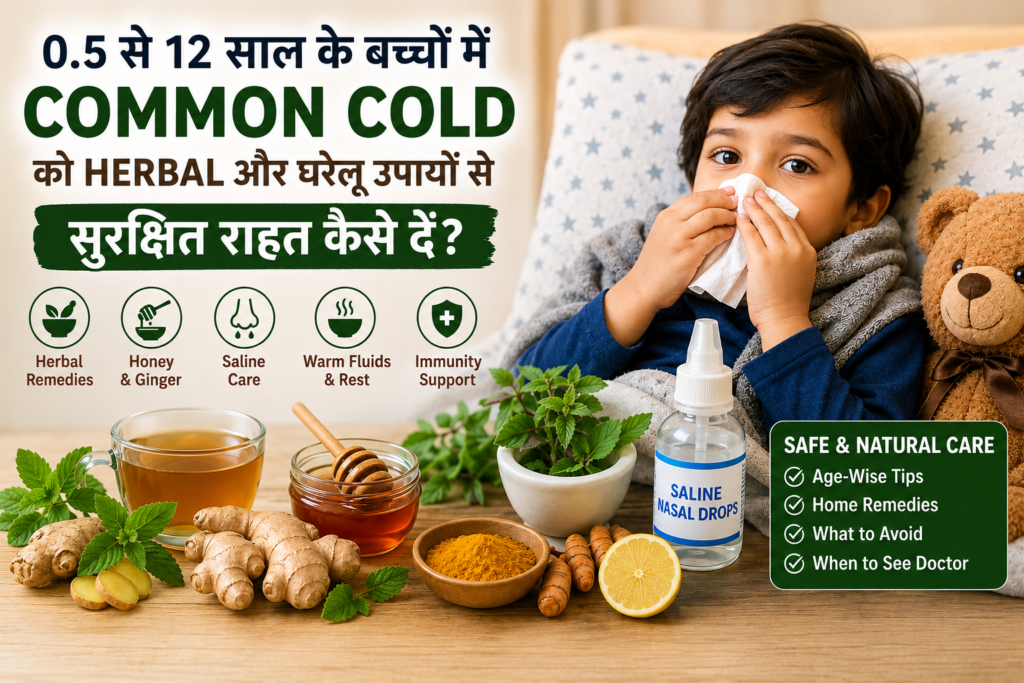
Home Remedies for the Common Cold in Children
The common cold is a very frequent issue among children. Young children may experience a runny nose, nasal congestion, sneezing, a mild cough, a sore throat, and sometimes a low-grade fever several times a year. In most cases, the cause is a viral infection, and the child begins to recover on their own within a few days.
Parents often use ginger, holy basil (Tulsi), turmeric, honey, warm water, or other herbal home remedies to provide quick relief to their child. While some of these items can help alleviate symptoms, it is crucial to understand that not every herbal remedy is safe for children.
Home herbal remedies must be used with great caution, especially for infants under 6 months and children under 1 year of age.
In this article, we will explore age-specific home and herbal remedies for the common cold in children aged 6 months to 12 years, and also identify which remedies should be avoided.
Important: Home or herbal remedies do not guarantee a “cure” for the common cold. Their primary aim is to provide comfort, alleviate symptoms like nasal congestion and coughing, and ensure adequate fluid intake and rest. If the child exhibits severe symptoms, it is essential to consult a pediatrician.
What is the Common Cold?
The common cold is a typical viral upper-respiratory infection. It affects the lining of the nose and throat.
Common symptoms in children may include:
* Runny nose
* Nasal congestion
* Sneezing
* Sore throat
* Mild to moderate cough
* Mucus in the throat
* Low-grade fever
* Mild headache or body ache
* Reduced appetite
* Fatigue or irritability
Most cases of the common cold do not require antibiotics, as antibiotics work against bacteria, not viruses.
Therefore, it is not advisable to administer antibiotics to a child on your own for a simple cold. Key distinctions for children aged 6 months to 12 years.
It is not safe to use the same home remedy for children of all ages
Under 6 months
Do not give the child any herbal drink, kadha (herbal decoction), or honey on your own at this age.
If the child is very young and experiencing difficulty breathing, feeding, or sleeping, it is best to consult a pediatrician.
6–12 months
Herbal mixtures and concentrated kadha should be avoided at this age as well.
Honey should absolutely not be given.
Honey can pose a risk of infant botulism in children under 12 months of age.
1–2 years
At this age, honey can help soothe a cough in some children. However, it is best to consult a pediatrician before administering herbal supplements or concentrated preparations.
3–5 years
At this age too, the primary focus remains on hydration, rest, saline, and—if needed—comparatively safer remedies like honey.
6–12 years
Older children can easily consume warm fluids, honey, and common home remedies, but this does not mean every herbal supplement is safe.
It is important to consider the child’s allergies, other medications, and underlying health conditions.
The most useful first home remedy for the common cold
Saline Nasal Drops
A stuffy nose is one of the most bothersome symptoms for children during a cold.
Saline a sterile solution with a mild salt concentration can help loosen nasal mucus.
For young children, mucus can be suctioned out very gently after using saline drops.
According to the American Academy of Pediatrics, saline drops or sprays can be used to relieve a blocked nose in children.
How to help a young child?
* Lay the child down comfortably.
* Using commercially prepared sterile saline drops or spray is the easiest option.
* Gentle suctioning can be performed on infants if necessary.
* Do not apply excessive force while suctioning.
* Do not put herbal oils, essential oils, or concentrated juices inside the nose.
If preparing a nasal rinse solution at home, the safety of the water is crucial. Untreated tap water should not be used for nasal rinsing; distilled, sterile, or properly boiled and cooled water should be used.
Honey: A useful home remedy for children over 1 year of age.
Honey is one of the home remedies for which there is some scientific evidence regarding its effectiveness for children’s coughs.
Some research has shown that honey helps reduce nighttime coughing and sleep disturbances in children.
But the most important rule:
Do not give honey to children under 1 year of age.
In children under 12 months old, honey can cause infant botulism.
1–5 years
About ½ teaspoon of honey can be used.
6–11 years
About 1 teaspoon of honey can be given.
12 years and older
Up to about 2 teaspoons can be used.
These dosages align with the American Academy of Pediatrics’ guidelines regarding cough relief.
Giving honey before bedtime may reduce nighttime coughing in some children.
However, dental hygiene should be maintained after giving honey because it has sugar.
Honey + Ginger: Can it be given to children?
Ginger is very commonly used in Indian homes during colds.
Ginger contains many bioactive compounds and has been used in traditional medicine for a variety of conditions, including respiratory symptoms.
However, strong clinical evidence of ginger’s effectiveness in curing the common cold in children is limited.
Therefore, ginger should not be touted as a “cold cure.”
For children over 1 year of age, a very mild warm drink with a small amount of ginger flavor may soothe the throat of some children.
But:
Do not give very strong ginger juice.
Do not give concentrated ginger shots.
Do not give very spicy kadha.
Do not force-feed the child.
Discontinue if stomach irritation occurs.
And absolutely do not give ginger mixture with honey to children under 1 year of age.
Tulsi: Traditional Home Uses
Tulsi is a popular medicinal herb in Indian homes and is traditionally used for respiratory symptoms.
However, there isn’t enough high-quality clinical evidence to support the use of Tulsi for treating the common cold in children.
It’s not advisable to give young children concentrated Tulsi juice or a kadha made with several herbs.
Turmeric
Turmeric is an important part of Indian cuisine and has long been used in traditional medicine.
But turmeric/curcumin cannot be considered a proven treatment for the common cold in children.
According to the NCCIH, while research has been conducted on the various health uses of turmeric, definitive evidence for many conditions is still lacking. Oral turmeric can also cause nausea, stomach upset, diarrhea, or other adverse effects.
So:
What to do?
Using turmeric in normal culinary amounts in food is generally more advisable than herbal supplements.
What not to do?
Do not give your child a high-dose turmeric supplement or concentrated curcumin product without medical advice.
The principle of “more is better,” especially in children, doesn’t apply.
Warm Fluids: Simple but Useful Home Remedies
A child can drink less water for a common cold.
Adequate fluids help prevent dehydration and soothe the throat.
According to age, children can be given:
Water
Little warm water
Soup
Broth
Age-appropriate warm fluids
Milk, if the child is taking it normally
According to the American Academy of Pediatrics, warm liquids can help soothe the throat and maintain hydration.
Do not give very hot drinks to children.
Should hot steam be used?
This is a very common household practice.
However, boiling water, hot steam, or open pots of hot water should not be used around children due to the serious risk of burns.
Accidental burns can occur during steam inhalation, especially in young children.
For nasal congestion, comparatively safer solutions like saline drops and adequate room humidity may be better options.
A cool-mist humidifier can be used, but it must be kept clean to prevent bacteria or mold growth.
Essential Oils with Caution in Children
Many people use eucalyptus, peppermint, camphor, or other essential oils for children’s colds.
But concentrated essential oils are not considered safe for young children and can cause irritation or toxicity if used improperly.
Therefore:
Do not put essential oils into a child’s nose.
Do not give essential oils to children to drink.
Do not let a child sit with concentrated essential oils in a steam inhalation.
If using a commercial product, follow its age-specific labeling and pediatric guidance.
Garlic
Many people use garlic as a traditional home remedy.
But there is insufficient clinical evidence for garlic’s effectiveness in treating the common cold. According to the NCCIH, there is insufficient clinical trial evidence for garlic’s effectiveness in preventing or treating the common cold.
Garlic in moderate amounts as a food is a different matter.
However, children should not be given:
Large quantities of raw garlic
concentrated garlic juice
garlic supplements
without medical advice.
Raw garlic can cause heartburn and stomach upset.
Should Echinacea be given to children?
Echinacea is marketed as a cold remedy, but evidence for its effectiveness in children is inconsistent.
According to the NCCIH, there is insufficient evidence regarding the effectiveness of echinacea in children, and there may be a risk of a rash/allergic reaction in some children.
Therefore, it should not be considered appropriate to give it to children as a routine home remedy.
Elderberry and Other Herbal Supplements
Elderberry, ginseng, echinacea, and various other herbal supplements are promoted for treating the common cold and flu.
However, there are limitations regarding the evidence for their efficacy and safety in children.
The NCCIH notes that there can be discrepancies between the actual ingredients in dietary and herbal supplements and the amounts listed on the label; additionally, issues such as contamination or drug interactions may arise.
Therefore, it is best to consult a pediatrician before starting any herbal supplement for a child.
A Safe “Home Care Plan” for Children
Home care for the common cold can be organized as follows:
Morning
Ensure the child gets plenty of fluids.
If the nose is congested, use age-appropriate saline drops or spray.
Gently clear away mucus, especially in younger children.
During the Day
Allow the child to rest.
Continue offering water and other fluids appropriate for their age.
Provide light, easily digestible food.
Do not force-feed if the child has a poor appetite, but ensure they stay hydrated.
Evening
If the child is over one year old and has a cough, honey can be beneficial.
Offer warm (but not scalding hot) fluids.
Night
Keep the room comfortable.
Use saline if nasal congestion occurs.
For children over one year of age, honey can help relieve coughing at bedtime.
Which Home Remedies Should Be Avoided?
For children, “natural” does not always mean “safe.”
Avoid the following practices:
- Giving honey to children under one year of age
This is the most important safety rule.
- Very strong *kadha* (herbal decoction)
Concentrated *kadha* made from a blend of herbs lacks established safe dosage guidelines for children.
- Giving essential oils to drink
Never do this.
- Putting oil or herbal juice into the nose
This can irritate the nasal lining.
- Steam from boiling water
This poses a risk of burn injuries.
- Adult cough/cold medicines
Do not administer adult formulations to a child on your own. 7. High doses of herbal supplements
Despite being “natural,” supplements can cause side effects and drug interactions.
- Administering antibiotics on your own
Antibiotics do not work for a common viral cold.
Should children be given OTC cough and cold medicines?
Special caution is required regarding over-the-counter cough and cold medicines for young children.
The benefits of these medicines may be limited, and incorrect dosages can lead to side effects.
Therefore, it is best to consult a pediatrician to administer the medicine according to the child’s age and weight.
Adult cough syrups or prescription medicines meant for another child should not be used, especially for young children.
When should you contact a doctor immediately?
Not every cold should be treated at home.
Medical evaluation may be necessary if a child exhibits any of the following symptoms:
Difficulty breathing
Very rapid or labored breathing
Chest retracting (sinking in) while breathing
Lips or face turning blue
Child becoming extremely lethargic or unresponsive
Inability to consume fluids
Signs of dehydration
Persistent vomiting
Very high or persistent fever
Worsening condition
Severe ear pain
Severe sore throat
Child becoming unusually irritable or lethargic
Cough worsening significantly
Symptoms steadily worsening instead of improving
Fever or breathing difficulty should not be taken lightly, especially in very young infants.
How long does the common cold last?
The course of the common cold can vary depending on the child and the specific virus.
Runny nose, congestion, and cough may persist for a few days, with the cough often lasting longer than other symptoms.
If the child is gradually improving, taking fluids, and breathing normally, standard supportive care may be sufficient.
However, consult a doctor if symptoms worsen instead of improving or if new, severe symptoms appear.
Can herbal remedies prevent colds by boosting immunity?
Many products on the market are promoted as “immunity boosters.”
However, it is not scientifically sound to view any single herb as a “magic” immunity booster for preventing the common cold.
The following are more important for a child’s overall health:
Balanced diet
Adequate sleep
Physical activity
Adequate hydration
Hand hygiene
Protection from smoke exposure
Age-appropriate vaccinations
A healthy lifestyle is more important than any single herbal drink.
The correct principle regarding herbal approaches for children
An important principle should be followed when creating content about herbal health for children:
“Herbal” does not mean “safe for all ages.”
Children’s bodies are different from those of adults. They have lower body weight, their metabolism may differ, and safe dosages for certain herbs or supplements are not well-established.
Therefore, ask four questions when choosing an herbal remedy for children:
- How old is the child?
- Is there scientific evidence supporting the use of this remedy in children?
- Are there any safety concerns associated with it?
- Is the child taking any other medication or suffering from another health condition?
If the answers to these questions are unclear, consulting a pediatrician is the safest option.
10 Golden Rules for Parents
Rule 1
Do not assume every cold is an “infection requiring antibiotics.”
Rule 2
Do not give honey to children under 1 year of age.
Rule 3
Prioritize saline for nasal congestion.
Rule 4
Ensure the child gets adequate fluids.
Rule 5
Ensure the child gets adequate rest.
Rule 6
Avoid very hot steam.
Rule 7
Do not put essential oils into the child’s nose or mouth.
Rule 8
Do not administer concentrated herbal *kadha* or supplements on your own.
Rule 9
Do not give adult medicines to children.
Rule 10
Do not rely on home remedies if there is breathing difficulty or severe symptoms.
Conclusion
The common cold is very frequent in children; in most cases, it is a viral infection that resolves on its own over time. Therefore, focusing on safe supportive care rather than searching for an herbal medicine that “instantly cures” the cold is a more scientific and safer approach. For a stuffy nose, saline nasal drops or spray, adequate fluids, rest, and a suitable environment can provide significant relief to the child.
Honey can be useful in soothing a cough in children over one year of age; however, it should never be given to children under one year old.
Ginger, holy basil (Tulsi), turmeric, garlic, and other herbs are part of traditional Indian health practices, but their efficacy in curing the common cold in children should not be overstated. Factors such as safety, dosage, product quality, and potential drug interactions are also important when considering herbal supplements.
Most importantly, choose a remedy appropriate for the child’s age. Something that appears harmless for an adult could be unsafe for an infant.
If the child experiences breathing difficulties, dehydration, extreme lethargy, persistently worsening symptoms, or other serious signs, seek pediatric medical care instead of continuing with home or herbal remedies.